Artistic Freedom to Object Given Space at Flinch/Punch

Someone eyes protest art on a wall in a gallery
Irvin Aloise via Unsplash
Art and politics have always been entwined in a tumultuous dance between control and revolution. From the days of ancient Sumer to the modern age, art has been the subject of perpetual and often violent debate—deemed frivolous in one breath and dangerous in the next. It is culture, it is memory, it is preservation. It is an idea made manifest and given life, untethered by the will of any one person, including its creator. There is an immense power in art and symbols and the meanings a society attaches to them, a power which has been utilized by the leaders of the world in every era to eradicate, raise to action, and/or conquer a people.
The danger of art, Plato believed, lay in its ambiguity. It portrayed the world through a veil, blurring the purity of truth and steeping the world in shadow. In his eyes, consumers and creators of art existed in a state of eikasia, or shadow-bound consciousness: The state, in the allegory of the cave, of those who are bound within the cave and see the shadows projected against the cave wall as the only truth of the universe and the things that exist within it. It is also the state of those who escape their confines and reach the fire which projects these shadowed images, who now know the images to be falsified, and who believe themselves enlightened, yet they are unaware of the world, or the truth, that exists beyond the cave.
This blurring and confusion of ‘truth’ and reality was believed to distract and corrupt a populace. Therefore, to protect the masses, art must be controlled, censored, and limited to its most basic nature. Patterns, aesthetics, and mathematics. Unwavering, incorruptible truth.
But art is more than Plato allowed it. It is not merely a veiled representation of the world, nor a villainous manipulation of human emotion. Rather, it is raw humanity given form. It is expression and voice and community. “The very ambiguity and voracious ubiquitousness of art,” said Iris Murdoch in her book, The Fire and the Sun, “is its characteristic freedom. Art, especially literature, is a great hall of reflection where we can all meet and where everything under the sun can be examined and considered. For this reason, it is attacked by dictators, and by authoritarian moralists.”
The more it is attacked, the more it rises to action. Artists have been at the vanguard of resistance movements throughout history. Through paintings like Picasso’s Guernica and the etchings of Goya’s Disasters of War; through wheatpasted posters of dissent, graffiti, and various other mediums of street art; through guerilla theater and pop-up poetry readings, the voices of the people are raised, and the regimes are critiqued and brought low. Through art, community strengthens.
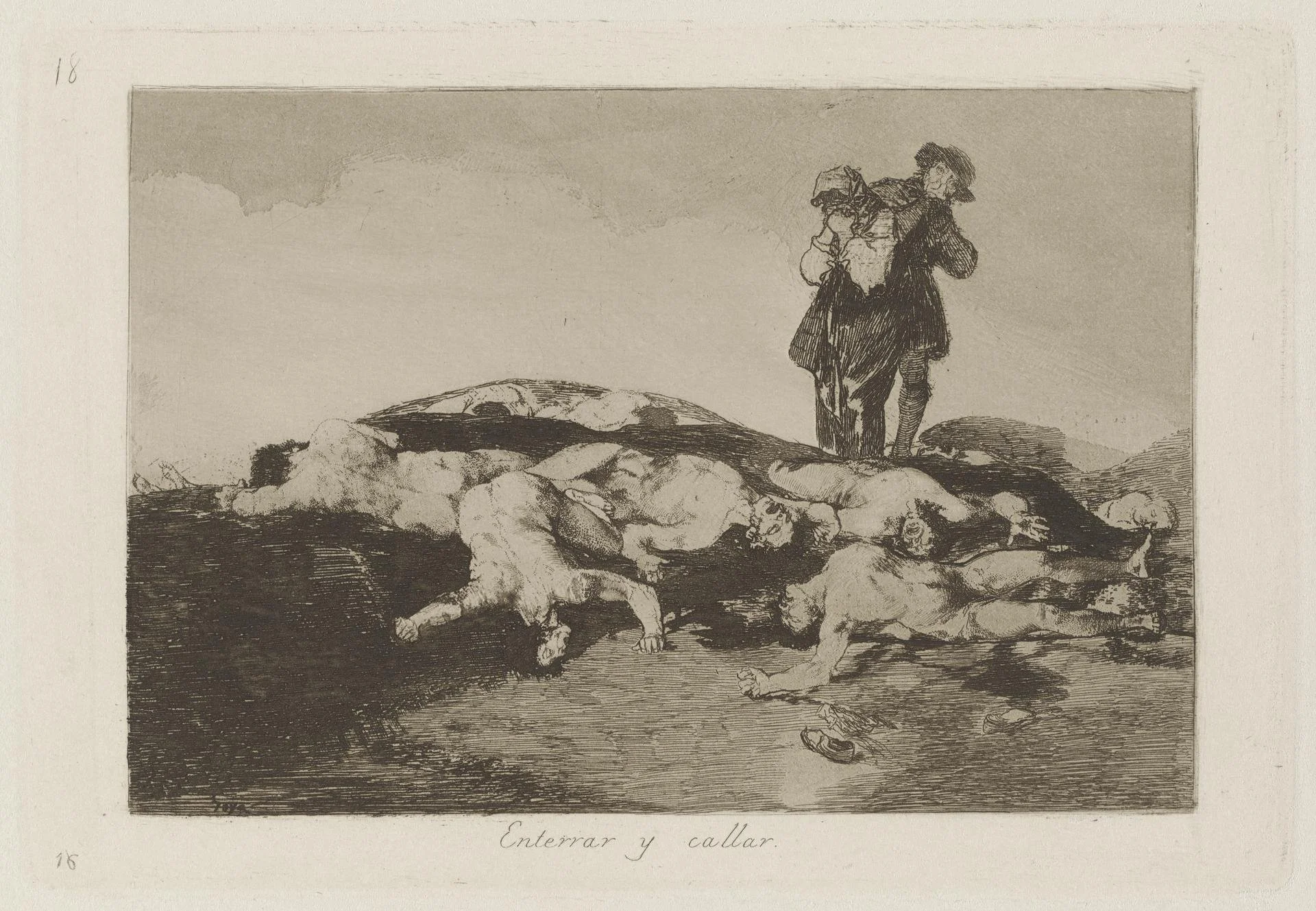
Goya. Disasters of War (Plate 18)
In 2011, the nation saw this put into action with the Occupy Wall Street movement. Artists of all mediums took to Zuccotti Park to organize, discuss, and create, standing against the 1% and protesting the economic disparity that followed the 2008 recession. Journalist Travis Holloway described the events in his article, “Performing Art or Democracy? On Poetry at Occupy Wall Street”:
[block] “Events like the Poetry Assembly began cropping up in a variety of art forms from music to theater to puppetry and even quilting,” said Holloway. “Largely organized online through collaborative and ‘shared’ forums, groups turned social media events into collective performances in the public space. One evening a jazz ensemble could be found in the square and the next a group of women knitting scarves for those sleeping outdoors and facing winter. Contemporary artists’ guilds were forming fast at Occupy Wall Street. People were finding each other.”
Nearly a decade later, Seattle witnessed its own version of the Zuccotti occupation with the Capitol Hill Autonomous Zone (CHAZ a.k.a. CHOP), where the masses gathered, traded goods, services, and philosophies, planted community gardens, hosted performances and film nights, and covered the area with murals and graffiti art, most famously the Black Lives Matter street mural painted by a collective of local artists.
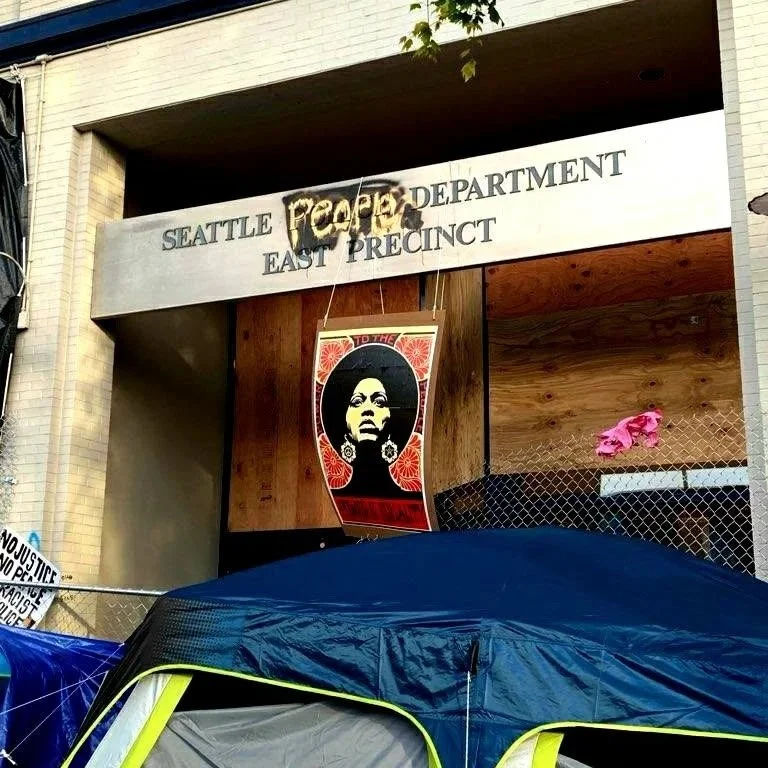
Inside Capitol Hill Autonomous Zone (CHAZ/CHOP), 2020
Ethan Lee
These spaces—these great halls of reflection—are necessities in our communities, especially in times of war, oppression, and authoritarianism. Annex Theatre, Seattle’s oldest fringe theater, saw this need growing as tensions rose amidst the 2016 election. So they developed a resistance program called Flinch/Punch.
Flinch/Punch ascribes itself to be a “Community resource for visceral responses to fucked-up times.” The program offers a chance at community and creative resistance through the free use of their theater space to host events that respond to the “current social, political, ecological, or cultural crises.”
Over the years, they have put on comedy shows, variety shows, movement jams, and even Baltic protest concerts. Most recently, they hosted WashMasks Mutual Aid and a workshop from a practitioner of Theatre of the Oppressed.
When interviewed about the program, Front of House Manager Jane Mattinson stated, “As a lifelong thespian, the last few years have really made me ask why we do theater. Is it necessary in this time of rising fascism to create a hierarchy between audience and performer, to highlight the privileged few with the time to rehearse, to essentially be gatekeepers to what voices get amplified? By reducing the barrier to entry for creators, we are trying to make theater—the oldest art form—into something valuable once again. For the masses. It is not the ivory tower, but the bloody streets that Flinch/Punch comes from. And I think right now, that connection to others is the only thing reminding me of the beauty of life.”
The creation and utilization of spaces like Flinch/Punch are vital to our communities and to the pursuit of progress and equity. Whether at events, galleries, protests, performances, or artist meetups, we must use the voice of art to stand together in solidarity and hope against the threat of tyranny.
In the words of Iris Murdoch, “A free art is an essential aspect of a free society.”