‘Ashes, Ashes’ Snapshots Family, Grief, Humor in Kenmore
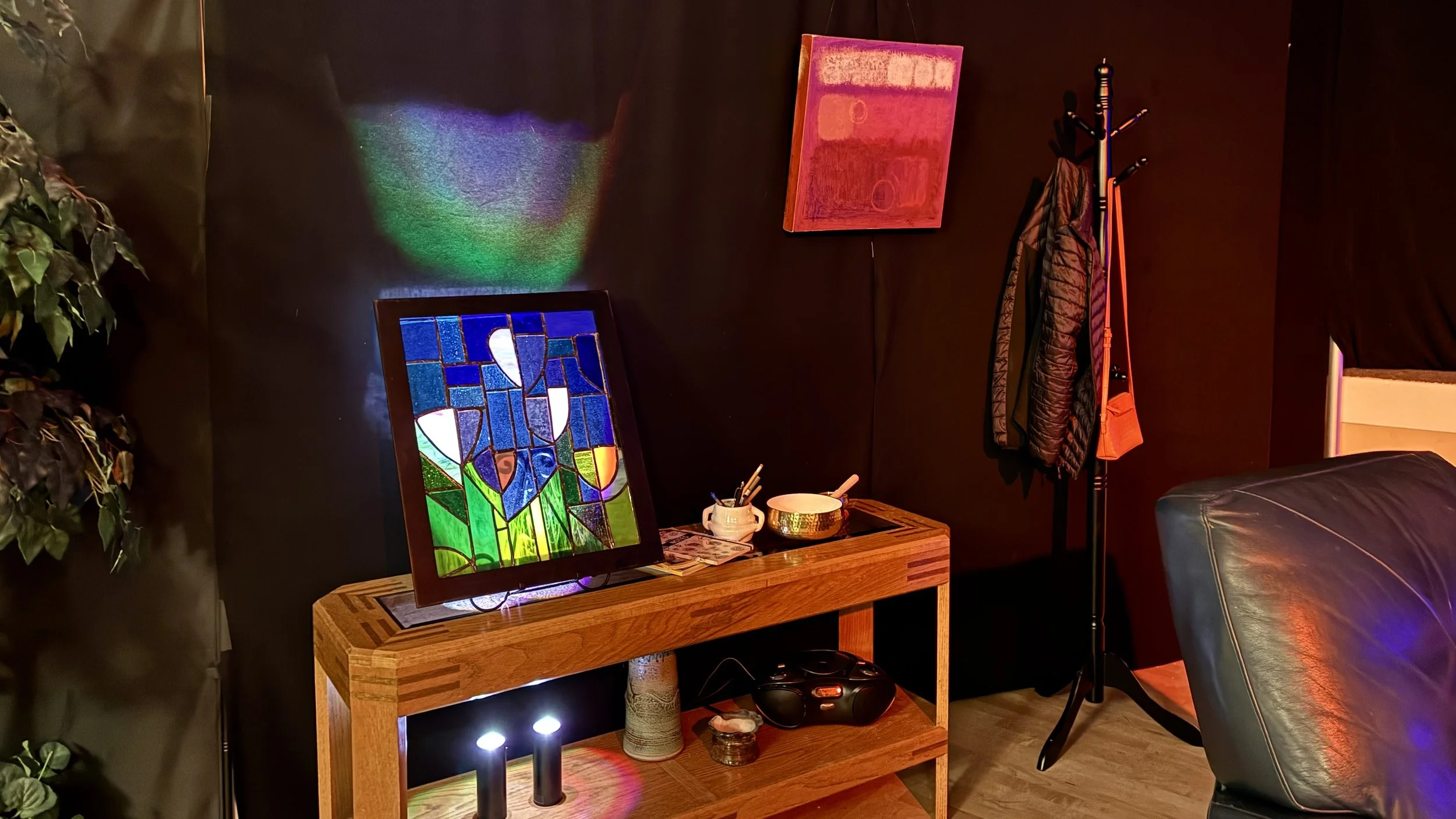
Set of Ashes, Ashes, We All Fall Down
The Evergreen Echo
Ashes, Ashes, We All Fall Down, written by Gretchen Douma, premiered February 5-8 at As If Theatre. The play, with its familial themes and living room-confined location suited the small, homey venue well. Staff greeted guests with warmth, ensuring all felt welcomed into the budding Kenmore arts community. Upon entering the Kenmore Community Club, a donation-based concession stand sold fresh, homemade cookies which added a unique layer of care, commitment, and connection to the performance and the theater space that often goes unfelt by patrons at larger venues.
Douma’s autobiographical play took a dark, yet comedic head-on look at a family experiencing the tumultuous nature of grief. When the matriarch of the Miller family passes away, her ashes are sent to the wrong daughter’s house. Madeline, who has been estranged from the family for years after her mother disowned her, receives the ashes in the mail and summons her two siblings, Charlie and Carolyn, to her home to decide what should be done with them. Here, conflicts both past and present come to a head, and the deep-rooted, familiar drama called family unfurls in a sobering yet humorous narrative.
Grief is a shattering and often nonlinear experience, and Ashes, Ashes confronts the bent path of that process, particularly how each Miller sibling navigates loss in their own way. For Madeline (Molly Hall), her mother’s ashes are just a pile of dirt. For Carrie (Skye Stafford), they are her mother’s body, humanity, and memory. And yet, neither of them is wrong for feeling that way. Meanwhile, Charlie (Jack Lush) fulfills the role of peacemaker, always trying to de-escalate the dramatic fire raging between his siblings. But in his own grief, he is frustratingly apathetic and distant from his own feelings, which is also a very real and valid experience.
Ashes, Ashes includes the deceased Miller parents’ ghosts as active conversationalists with both each other and the children who are able to see them. Charlie never sees either ghost, but Carrie sees her dad, and Madeline sees her mom. This allows for some fun misunderstandings between the siblings as two of the three were also having side conversations with spirits in the middle of heated debates. In one scene early on, Carrie drives her father William (Bradley Goodwill) to Madeline’s house, and, half-dazed by Alzheimer's, he speaks about the waves and the weather, convinced he is onboard a sea-faring vessel. It is only later, once they arrive at the house, that we realize that William is a ghost attached to Carrie who is keeping his ashes in an urn.

As If Theatre’s program
The Evergreen Echo
The standout performance of the show was Judith Shahn as Vivian Miller, the family matriarch and source of much of Madeline’s angst. She first strides into the living room in a silk robe, holding a cigarette, and demanding reverence. Sharp, stubborn, and full of blithe spirit, Vivian charmed the whole audience all while being a deeply flawed character. We watch as she sees the consequences of her choices in the division her children are experiencing. She also goes through her own process of grief for the relationship she had lost with Madeline.
The acting was a little rough in places towards the beginning as the actors were getting a feel for the audience, but as the play progressed, we watched the cast settle deeper into their roles, emboldened by laughter from the audience. Ashes, Ashes was strongest when it leaned into absurdity and humor. The love between the siblings felt realest in their muddled cocktail of resentment and zany nonsense.
The play not only captured audiences with its narrative and performance quality, but also with its usage of space. The set design established a cozy living room that felt enclosed, yet breathed enough for the audience to imagine where the home’s layout expanded into other areas such as the kitchen, bedrooms, and entryway. Decorated with Vivian’s artwork, comfortable seating, a rug, and various shelving units filled with trinkets and objects tied to myriad memories which the characters reflected on and interacted with, the space felt alive and thick with history.
Behind the living room, a smaller, raised and curtained off proscenium unveiled a space separate from the living room where Carolyn and William enacted their long drive to Madeline’s house—which ran parallel to the narrative in the main house—allowing the play to proceed largely uninterrupted by scene changes. With the mere modification of lighting and the actors’ freezing in the living room, audiences were transported back and forth between locations, making a confined space feel as though it enveloped the potentiality of the world.
The play as a whole was wonderfully written, filled to the brim with character and emotion. It well encapsulated the conflict-riddled yet loving relationship between estranged family members brought together by grief. It kept the audience on their toes and wielded humorous moments like a scalpel, perfectly incising bits of morbid laughter into a deep, emotional narrative. At its conclusion, it was met with a standing ovation.
Next on As If’s lineup is Dipika Guha’s Yoga Play, directed by Agastya Kohli and running from March 19-April 5, 2026. As always, As If maintains its pay-what-you-can model for tickets in the hopes of making theater more accessible to Kenmore’s local community.