
Biennium Rollercoaster: Top 5 Bills Ripe for People Power
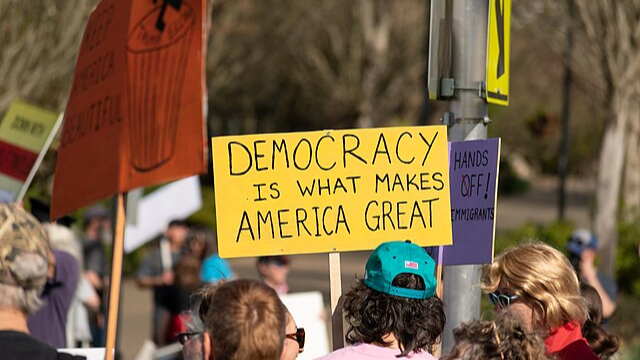
Hands Off Rally, Olympia WA, 2025
Washington has reached the second month of the second year of the two-year legislative cycle known as the 2025-2026 Legislative Biennium. The coming weeks will sort out which of the thousands of bills introduced will remain on a path to Governor Ferguson’s desk, and which will have to find their hopes with a new bill in a future session.
Meet five bills introduced this biennium, their stories, and their hopes for the future.
Status: Dead in the 2025-2026 Legislative Biennium
If ranked-choice voting (RCV) is such a great idea, why doesn’t everyone do it? The Washington Voting Rights Act is one answer you may not have expected. Without getting into the legal details, the high-level explanation is that as a system still in the “adopting soon” phase for ranked-choice voting, one challenge for municipalities and election administrators is maintaining confidence that the way they run elections will not run afoul of election laws that have primarily been designed and understood for “first past the post” / “winner take all” elections. How do we apply those laws to an entirely different voting system? The fear of a violation alone could be enough for a city to avoid adopting it all together.
What the VOICES (Voting Options, Implementation, Compliance, Education, and Standards) Act intends to do is to have Washington State define “correct protocol” for RCV elections and therefore support every municipality trying to adopt by providing clear guidelines on how to implement without violating state election law. The clear standard should both remove any hesitation based on legal concerns while also creating an implementation template for all cities to follow rather than having each duplicate that work.
The modern movement for RCV is to a large extent driven by the national FairVote organization, and the VOICES Act is the baby of our state chapter, FairVote Washington. The journey of RCV here has been a strange game of footsy for many years, but through FairVote Washington’s persistence it is coming to Seattle in 2027. Many municipalities are likely taking a “wait and see” approach with regards to Seattle—the VOICES Act could be the difference between wide adoption versus it being another one of those “Seattle things.”
Presenting it as HB.1448 (no Senate companion) through the House Appropriations committee all the way to Rules in 2025—just one stop short of a floor vote—you might have thought that 1448 had good momentum. Instead it made no further progress in the 2026 session. It’s always difficult to say why, but based on the general tenor of the legislature it’s likely that it struggled to get the needed attention alongside the scramble to address the budget shortfall.
Status: Through the Senate, backed by leadership. Always has a chance.
And so it has come to pass that Washington faces its largest budget shortfall in its history, one so bad that it has politicians whispering things like “wealth tax,” “income tax,” and “progressive revenue.” It can create strange bedfellows of deficit hawks, neoliberals, and socialists. Cuts? Surely we can find some. Taxes? We kind of have to. How much? A fair amount! Who? You go first…
Who knows where the real proposals on tax reform in Washington are born, but this one has been introduced by Majority Leaders Senator Jaime Pedersen and Representative Joe Fitzgibbon. One way you know that it’s from leadership is that it was introduced on day 24 of a 60-day legislative session and was moved almost immediately into the necessary committees to keep it on track.
But the real work has been done for years across organizations that advocate for tax reform in Washington like the massive Balance Our Tax Code coalition and partners/members like the Washington Budget & Policy Center, Economic Opportunity Institute, and many others. The fact that it’s moving forward now with leadership backing in both chambers of the legislature is more reflective of an idea whose time may have come.
Still, the path is long and full of obstacles. Will it make it to the House floor? If it does, does it really have the majority it needs? If so, will the Governor veto it (he’s claimed so far he doesn’t support it in its “current form”)? If the Governor passes it, how long before it goes to court? If it passes muster in court will it survive on the ballot when an inevitable “no” campaign comes for it? And does all this uncertainty make it a little bit hypothetical when it comes to balancing the budget?
The term “trial balloon” gets thrown out when this is discussed in community spaces and it’s hard to argue that it’s more than that at this time. It’s a fairly limited tax arguably designed to weather the legal and political hurdles to establish a foundation for taxing income in Washington. It’s a chapter in a longer story about progressive tax reform. It’s been five years since the capital gains tax passed, which has moved Washington from the most regressively taxed state up one place to now the 49th most regressively taxed state (your move Florida).
If you’re passionate about tax policy or having the wealthiest among us pay their fair share, you can email your legislators about the Millionaires Tax (SB.6346).
SB.5352/HB.1404 - Free School Lunches
Status: Dead in the 2025-2026 Legislative Biennium
What does it take to get a free school lunch bill passed in Washington? Apparently more than the Governor’s backing. SB.5352/HB.1404 was introduced “By request: Governor Ferguson” early in the 2025 session to an absolutely stacked list of cosponsors which notably did not include Majority Leadership in either chamber. While in 2025 it received public hearings in both chambers’ policy committees, it failed to advance through either one and didn’t move a muscle in 2026.
Free school lunches is one of those ideas that is intended to be so agreeable that its passage can be seen as a sure thing. Who’s really going to take a stand against taking the profits out of feeding school children? But then you realize that it went down much the same way in the 2023-2024 biennium and you realize that someone must not like this bill. Is it the cost? Is it the cost? Is it the big school lunch lobby? Wherever the opposition comes from, it’s got some political power because these bills hardly went anywhere in the 2025-2026 biennium.
HB.1238, titled “Providing free school meals for all” passed in 2023 and we wonder: Do we have universal free school lunches or not? The short answer is that past legislation, despite its framing, primarily targeted low-income schools and students rather than creating a truly universal and equal-access free lunch program. So in that sense it’s easier to see these bills that went nowhere in 2025-2026 as part of a work in progress—a work in progress that has a champion in Senator Marcus Riccelli, a prime sponsor of these proposals since he debuted them back when he was in the House.
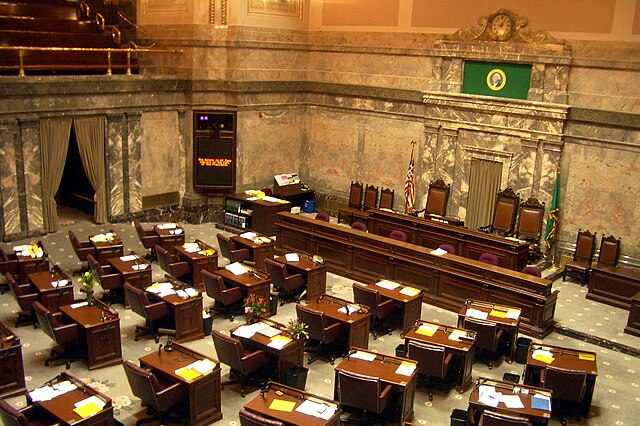
Washington Senate Chamber
Status: Dead in the 2025-2026 Legislative Biennium
If you managed to get a word in with an elected state legislator this session it’s very likely that the first, second, and third thing on their mind was the state’s budget shortfall. While woes over taxes and spending hang over every session in Olympia, the current shortfall is widely considered the worst in the state’s history and hence every policy conversation is first and foremost a conversation about costs and revenue.
Public baking as a proposal has been introduced into the Washington legislature since 2009. Its best known champion has been Sen. Bob Hasegawa, first elected to the House in 2004 and then into the Senate as of 2012.
If you’re wondering what you would need a public bank for, the first thing to clarify is that while a public bank could in theory provide individuals an alternative to a commercial bank for their financial services, the primary users would in fact be Washington state itself and its municipalities.
The pitch is that public money is typically held in for-profit and often out-of-state institutions like Wells Fargo. Those institutions charge interest for their services, meaning that taxpayer money is moved out of the state and into a private institution’s investment portfolio.
So what if instead public money was held in a public institution, and what if the investments of that institution were cycled back into the community? In this way, public banking can both reduce the cost of government while also raising revenue through investment rather than taxation, an often more politically viable source of money. The catch is that establishing a public bank requires start-up capital with revenue and savings only happening over a longer period of time.
Compelling pitch aside, public banking has struggled to get traction in Olympia for years, but the 2025-2026 session offered just enough hope to feel let down. SB.5754 made it through its policy committee in 2025 and continued on strong with a relatively early hearing in Ways & Means. The testimony at the hearing was compelling and largely positive, but a significant and largely anti-tax mobilization ended up edging out the support and it was not scheduled by the Chair for a vote.
And so it goes, public banking continues to be an interesting idea in Olympia, one that advocates say leaves a lot of money on the table, and one that is already proven in another state. (The Bank of North Dakota has operated for over 100 years and returned more than half a billion dollars in profits to its people). So will public banking stand a better shot in a future session? Only time will tell.
HB.2489 - Decriminalize Homelessness
Status: Dead in the 2025-2026 Legislative Biennium
Housing prices in Washington continue to rise to new historic highs and are a top contributor to a more broadly felt cost of living crisis demanding policy solutions. It’s unfortunate that despite this great need, primary policy discussion in the 2026 session has not been to increase housing supply or address costs, but instead to better manage the state’s unhoused population. Still more disappointing: it’s dead in the House Rules Committee.
HB.2489 was introduced in 2026 by an impressive cohort of 25 House Representatives and backed by the Seattle/King County Coalition on Homelessness and the Washington chapter of the ACLU whose one pager explains, “The Shelter, Not Penalties Act (HB 2489) establishes a clear and consistent statewide standard: Local governments may not adopt or enforce ordinances that criminalize, penalize, or otherwise prohibit people from engaging in life-sustaining activities on public property unless it can demonstrate that adequate alternative shelter space is available.”
It’s an interesting system of carrots and sticks that the state is attempting to set up for its municipalities to navigate. On one hand it makes it harder for cities to criminally penalize homelessness while incentivizing the creation of shelter. On the other, it uses the presence of those shelters as the permission a city needs to maintain a punitive approach to homelessness. Meanwhile it’s unclear if this approach actually does anything to get the unhoused into permanent supportive housing or address the rising cost of housing.
If governing Washington was a TV series, then the 2025-2026 “season” would have been one of those penultimate seasons that sets up a finale. Federal cuts and a historic budget shortfall have set the stakes—it truly feels like change is upon us. Many main characters and policies that have long bided their time are now taking position as serious possibilities that promise to end a crisis. And yet nothing so significant seems to have happened yet.
Big ideas like ranked-choice voting, public banking, universal healthcare, and progressive taxation all continue to tease the soon-to-be possibility that has not quite yet arrived and future battles await before they do.
