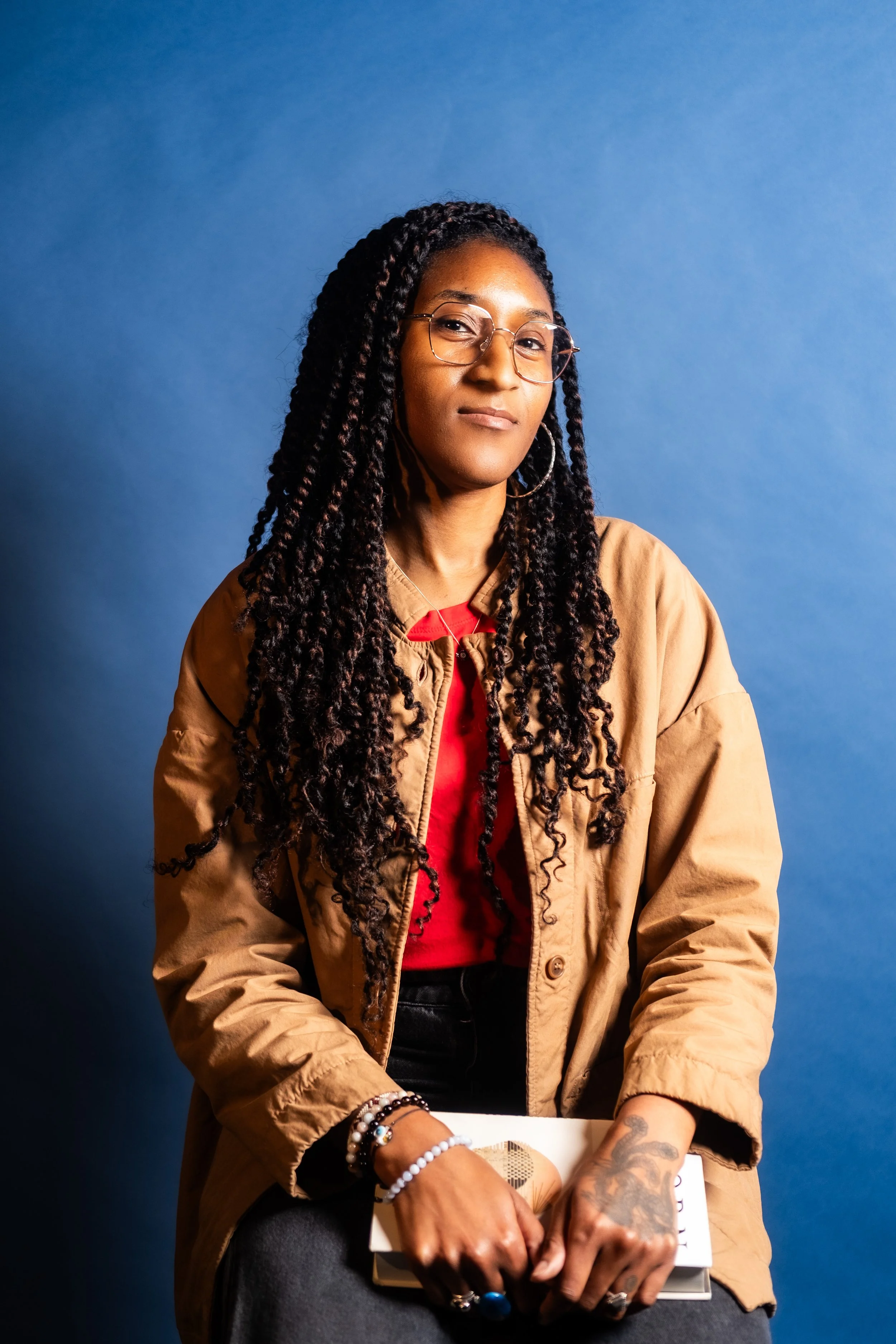
Evergreen Style: Barakah Beauty Collective

Michaela (L) with Olayinka (R) of Barakah Beauty Collective
Courtesy of Barakah Beauty Collective
When it comes to fashion design and media, modesty is not often a consideration. Trends center on body-conscious silhouettes and marketing buzz rather than personal comfort or values. This makes women like Michaela Corning—whose style is a unique combination of culture, personality, and spirituality—feel isolated.
After being unable to find clothes that reflected both her identities and beliefs, Michaela started a fashion label with her namesake, Michaela Corning LLC, in 2021 and has been on a mission to make modest fashion more accessible ever since. One year later, she launched the Barakah Beauty Collective to cultivate a space where fashion, faith, and fellowship could coexist.
This month, I visited the storefront in Northgate to talk with her about the business, the long-term vision, and the ways community members can help foster greater inclusivity in fashion.
**Note: This interview has been condensed and edited for brevity.
JeLisa Marshall (JM): What is Barakah Beauty Collective (BBC)? What does it offer to the current landscape of beauty and wellness?
Michaela Corning (MC): What we offer [...] is a very diversified group of services by a group of women that vary in ages and cultural backgrounds. We really, truly make sure that we’re servicing all people in the community: folks that speak multiple languages and understand beauty through different lenses, and not just through the white lens. I mean, we have a lot of white folk come here, but the vast majority of our customers are like, oh, my hair, for example, got screwed up at (fill in the blank). It’s interesting because that has been a common theme across many different cultural backgrounds. We’ve heard that from Asian women, Black women, Arab women, Indian women.
I would say on the wellness front, we have someone, Asiya, who is an integrative medicine practitioner. I think a lot of people use some of this terminology, and it’s not that integrative. [Unlike] someone like herself—a nurse practitioner, midwife—who graduated from Seattle University and worked in the Swedish medical system, and then she also has a master’s degree in Chinese medicine from Bastyr, and another degree or specialization in herbs and nutrition. I mean, the woman has like 10 degrees. So, she’s able to provide this extremely holistic approach to feminine health. She’s approaching things not just emotionally and physically, but also spiritually. [While] not necessarily specific to Islam, when Muslims come in, they feel protected and cared for and safe, and [can say:] I want you to play the Qur’an, for example.
JM: What about the fashion?
MC: The fashion component is, in reality, our anchor business that’s made in Seattle primarily using overstock fabrics and upcycled. I think that set a precedent here, you know, for the types of businesses that we attract and also [the] type of customers we attract.
Someone like Olayinka, who’s a brand new entrepreneur here, who specializes in African couture and special occasion. She does custom alterations, like way above what I can, so that is very in line with my fashion business. I would argue that we’re both in sort of this cultural fusion space [and] we flex wide when it comes to the sizing. A lot of the things that I make are kind of oversized, for up to like 2-to-3x, depending on different factors. I also have sized things that go from extra small to double XL, like with pants and tunics.
Earlier today, Olayinka was doing a custom piece for a Palestinian family getting married. One of the daughters, who’s not the bride, has very curvy hips and a very small upper body—absolutely impossible to find something off the rack. Right? The fact that she can get something custom made to her size, have it completely fitted, and then, be like ‘well, I want this to be more modest.’ Also, in a space where [people are] not going to walk in, [she] feels protected to take [her] hijab off. I think [it is] a very special and unique thing to what we’re doing. You know? Slow fashion and women-centered fashion.
JM: You mentioned some of the women who work here with you, but who are the rest? Designers?

Alejandra aka "Ale" (L) with Michaela (R)
Courtesy of Barakah Beauty Collective
MC: Pretty much everybody who’s here is an independent micro-business. We have a couple staff members that we’ve been able to secure through work study at UW, because BBC is a non-profit. So, we do have a couple women who are UW students, who kind of float around and help us at different levels. Some folks are yearly contract members, entrepreneurs, and others kind of flex in and out depending on what they need.
Right now we’re on the verge of really going hard on a virtual membership model for people who maybe aren’t quite ready to sign some agreement or have the wherewithal to do that for whatever reason. They can benefit, at some level, from the network, the business, coaching, [and] all those things for like a small monthly fee, without maybe feeling like the stress of having this big rental commitment. I think that model works well for us, trying to maintain the wheels on the bus here.
Even more importantly, I think it’s exactly what a lot of micro-business owners need. They just need a little bit of access to the community, access to the entrepreneurial members in orbit here, and benefit from our network at a more reasonable cost level. We have a yoga instructor. We have another fashion person. We have a couple different artists that do workshops here as well. We have a food person as well. In the past, we’ve had a robust group of consignment folks that were selling things in the space.
JM: How has building this sisterhood, and uplifting and amplifying entrepreneurship helped you and what you’re doing with the anchor business?
MC: If we’re talking purely financial, it hasn’t helped me. I mean, reality, that’s not where we’re at right now. Now, insha’Allah, in the future we’ll get there, and there will be some financial benefit for me personally, but that’s not really why I did [this]. My initial goal was very community focused. I felt like I can’t be at home anymore because my personal business has just outgrown my space.
I was walking the neighborhood. I saw the space was vacant. I contacted the landlord, and looked inside, and I thought ‘oh my God, this is a perfect space [and it] would be so cool if we had a women-only hair salon.’ And then, I was like, ‘I wonder who else would be interested in being a part of this and it would be a cost-sharing model.’
So, it would help me, but obviously help other people. And then, I started thinking, ‘well, God, you know, people are always asking me for business advice, coaching advice, selling advice, all the things within our community.’ Doing some sort of coaching business is like a whole new business, but if we’re in this space, this is going to be like this natural coaching. I’m sure everybody else has their expertise and things that they can also lend to me, so it’s just very reciprocal. Being in this position is a huge Amanah [Arabic for “trust”] for the women who depend on the space.
JM: On that note, knowing BBC is a community pillar with a deep responsibility, why add more components—like the community closet, for example?
MC: So, our community closet used to be in a room, but we had to make a decision between, do we open that space up to have another entrepreneur, or keep that space with clothes for when someone happens to come in. We do get a lot of traffic for people needing things from the closet, but I felt like empowering that one woman as an entrepreneur made a little bit more sense.
It’s not like we’ve closed the closet. What we’re trying to do [now] is have more of a pop-up model with it. Maybe every couple months, we have an event and people come and can take things, unless they just want to order off the website. Then, we curate based on their requests. These [requests] are mostly from new Muslims. We kind of limit the space for things that are like long and loose and like cultural clothes.
Blazers and some just extra stuff that sometimes we have, we put [on the rack outside]. I’ll say that it is an extension of the community closet, because everything on that rack is $5. I’m just kind of popping things out as we get donations.
JM: You also have a fashion show in the works. Where did the idea for that come from —your background in running your own fashion business or something else?
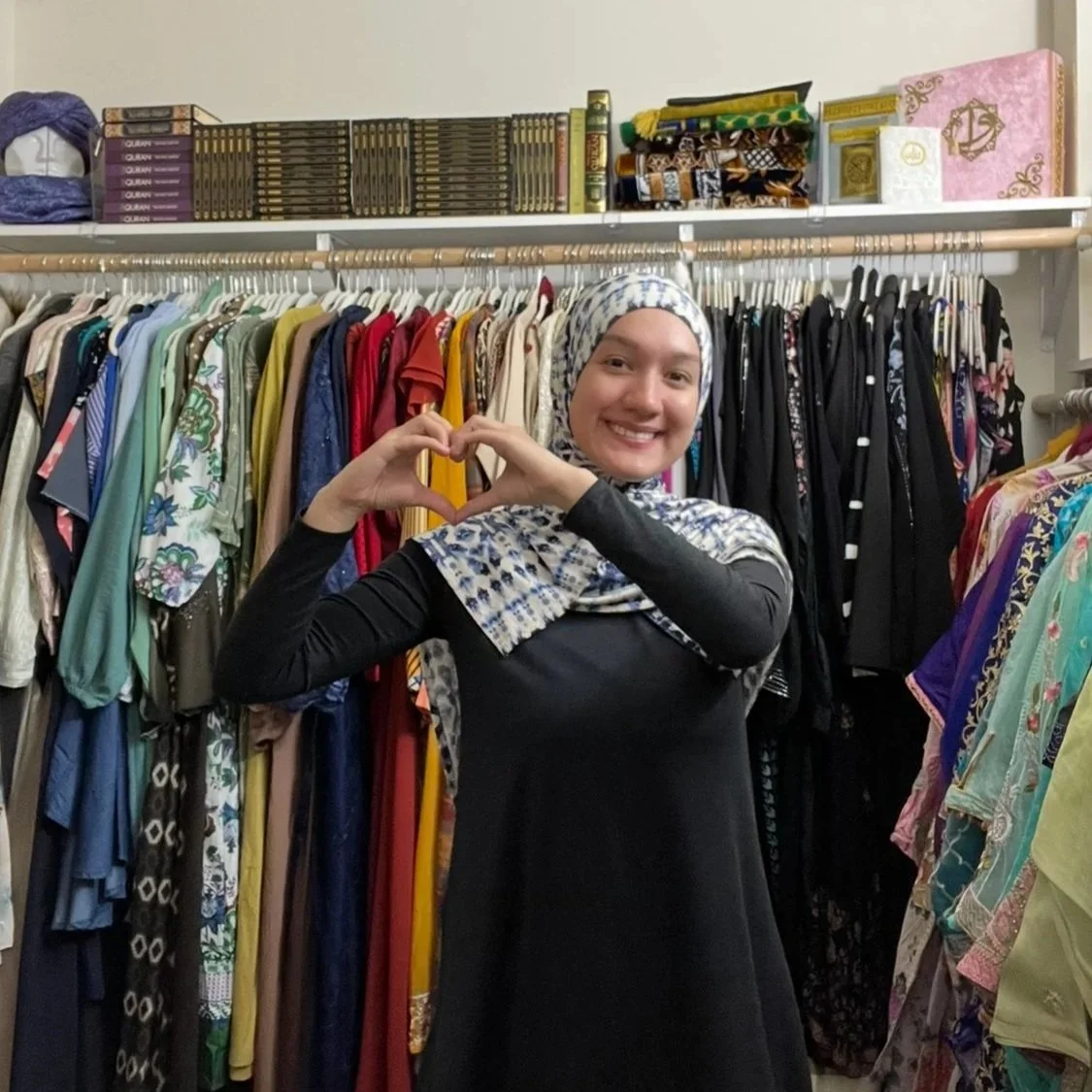
Necia in front of a full rack of clothing
Courtesy of Barakah Beauty Collective
MC: I’m thinking about fashion all the time. What’s ethical? What’s sustainable? What’s needed? So, Threads of Renewal is a fashion show that me and Rahma, who I’m partnering with on it, [created]. She is a local modest fashion business owner herself, who was doing pop-ups that were focused on the Muslim women specifically, and that’s how we met. The fashion show is such an opportunity for women entrepreneurs, especially if you do it well and do it right. It wasn’t just like out of the blue. We’ve done certain things before, like the Arabian Nights Pop-Up in Edmonds, and we’re just kind of bringing it all together. We have a fashion segment, a small performance, a fashion segment, a small performance, [and] so it kind of has some breakup.
JM: Where do you see BBC in the next few years, and how can the community support you in that vision?
MC: At the end of the day, we are trying to uplift women in our community. Coming here proactively and booking services or buying is at the heart of what we’re doing. I do see a couple [of other] things. One, I want to franchise BBC, whether that’s local or outside of the state. I also envision that the space has a prayer hall with, maybe, a Friday prayer or something that’s open to men, but that it still remains driven by women.
By centering the needs of Muslim women, while welcoming women from all walks of life, Michaela is expanding the meaning of fashion beyond clothes toward community. As BBC grows, so does its presence within the Pacific Northwest and beyond. The collective was recently featured on New Day Northwest and has cultivated a strong following on Instagram, TikTok, LinkedIn, and Facebook. Join BBC online or the Northgate store to experience how modesty is shaped by care and connection.