We Are Zoorkhaneh Bridges Generations + Cultural Understanding
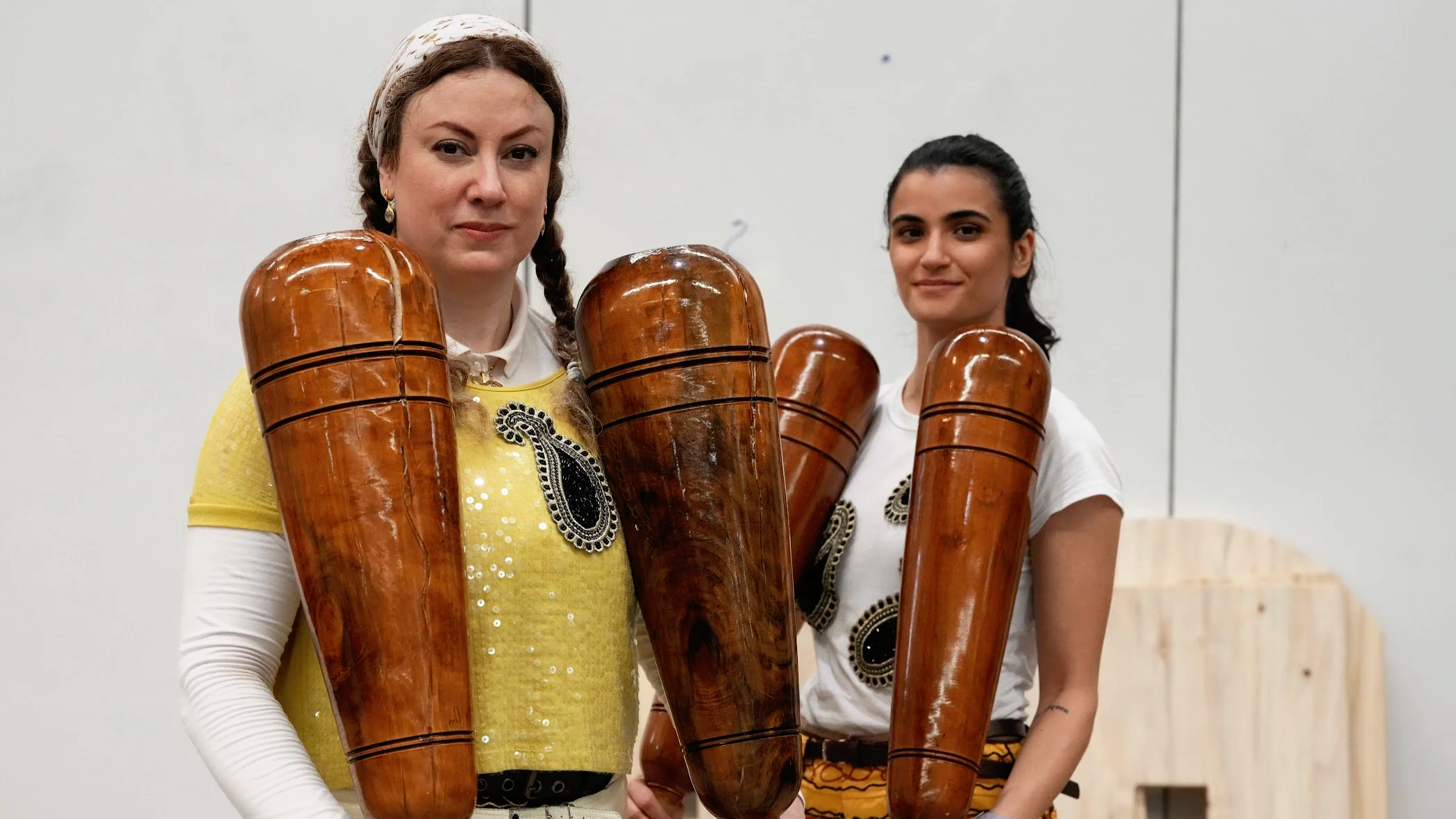
Farnoush Djavaheripour (L) and Sara Modjib Shirazi (R) holding mils (Indian clubs)
Alfred Meza / Courtesy of Sara Modjib Shirazi
History
In 16th century Iran, the Safavid Dynasty ruled Persia with the desire to unite the nomadic peoples of the land under one Persian identity. They established Twelver Shi’ism as the official state religion and solidified the nation as a political and militaristic force. This cultural union of the Iranian plateau, the Caucasus, and Mesopotamia created a unique identity separate from the neighboring Ottoman and Uzbek empires and laid the foundations of modern Iran.
Amid this political upheaval, the cultural fusion of these regions seeped into the day-to-day practices of the common people. One such example was the emergence of Pahlavāni and Zoorkhaneh, an athletic ritual-sport rooted in Islamic, Gnostic, and Sufism ethos.
Pahlevāni, stemming from pahlavān (پهلوان), meaning hero or champion, and Zoorkhaneh (پهلوانی و زورخانه ), meaning House of Strength, originated among wrestling guilds in the 16th and 17th centuries and evolved throughout the eras. The sport today consists of a series of calisthenic and strength training exercises accompanied by the beat of the zarb drum and the recitation of Persian poetry and epics by the morshed (the master), thus balancing physical endurance with philosophy and ethics, teaching students that the strength of the hero warrior is rooted in honor, humility, and morality.
At the center of these philosophical recitations is Rostam, a character from Ferdowsi’s Shahnameh: The Persian Book of Kings, who exudes the qualities of the supreme pahlavān. He is described as “a champion whose power is matched by courage, loyalty, and endurance. His legendary feats, including the Seven Labours, made him the enduring model of heroic masculinity in Persian culture.” Alongside Rostam, Imam Ali is often invoked through the morshed’s verses, representing the discipline of strength.
Traditionally, the Zoorkhaneh has a lowered hexagonal shaped pit called the gowd where the exercises take place. The door to it is low, urging humility when one enters. Around the gowd are stands for observers, and elevated on the outskirt sits the morshed with his drum. The senior-most member of the group, the miāndār, leads the session from the center of the gowd. Participants enter the gowd, touch the ground, and raise their hand to their lips to show respect. From there, they embark upon various movement exercises, warming up the body then utilizing unique instruments shaped to resemble old weaponry that enhance movement control. Most prominent of the instruments are the Takhte-Shen (push up board), the Mil (Indian clubs), the Kabadeh (iron bow with heavy rings strung upon the cord), and the Sang (wooden shields).
By the early 20th century, the practice of Zoorkhaneh dwindled near to elimination. In 1934, however, a millenary celebration of Ferdowsi and his poetry brought Zoorkhaneh centerstage in the eyes of the Iranian public. Its popularity erupted, the drumming and poetry broadcast on Radio Iran so people could partake from home.
To this day, it prevails as a symbolic display of cultural identity and patriotism. Despite its evolution and revived societal importance, the practice remains limited only to men. Naturally, this means women have taken the sport into their own hands, training themselves and studying with each other where professional training has been denied them.
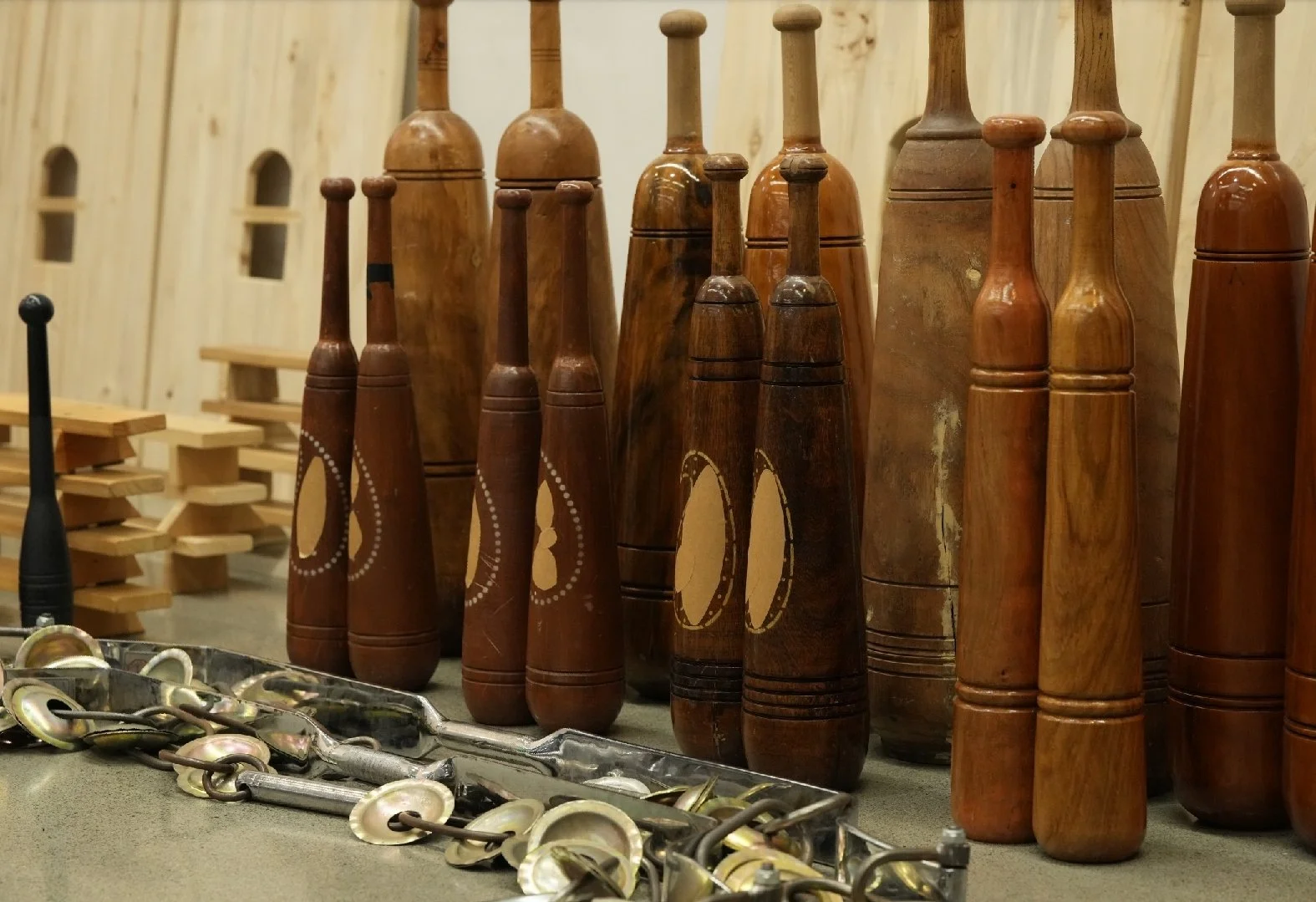
Mils (Indian clubs) used in Zoorkhaneh practice
Alfred Meza / Courtesy of Sara Modjib Shirazi
We Are Zoorkhaneh
One such woman who has risen against the limitations put against her is Sara Modjib Shirazi, the founder and Program Manager of We Are Zoorkhaneh, who I had the chance to interview after their recent Zoorkhaneh workshop at Alder Hall in the U District.
Sara was first introduced to Zoorkhaneh through her father. She was raised biculturally between her Italian mother and Iranian father, and spent her primary years navigating the blurred space around the edges of each. Having lived in Italy through most of her early life, her father became the “central bridge” between her and her Iranian heritage. “Through traditional foods, such as kubideh, ghormeh sabzi,” she said, “through celebrations, such as Nowruz, Yalda, and Chaharshanbe Suri; and through stories rooted in Iranian history and mythology, he ensured that our heritage remained alive within our home. Zoorkhaneh, in particular, was never presented to us merely as a sport. My father spoke of it as an ethical tradition: a discipline through which humility, integrity, respect, and moral conduct are cultivated alongside physical strength.”
On a visit to Iran in 2015, Sara and her father came upon a Zoorkhaneh training session. Intrigued, she asked if she could enter the gowd and try the mil. “His answer was immediate,” she said. “Women were not permitted to participate.”
Five years later, during the two-week lockdown, the idea of We Are Zoorkhaneh took root. “I began thinking seriously about how this tradition might be reimagined and made accessible beyond Iran,” said Sara, “particularly for younger generations in the diaspora.” She saw Zoorkhaneh as a potential cultural bridge that would help link second-generation Iranians to their heritage in a meaningful and embodied way.
With the help of Farnoush Djavaheripour, a professional woman Zoorkhaneh instructor, and Dariush Bayat, a Vancouver-based instructor who donated large quantities of the necessary equipment, We Are Zoorkhaneh gained life. “The urgency of the project deepened significantly following the Iranian protests of late 2025 and the violent crackdown that followed in January 2026,” said Sara. “Like many second-generation Iranians, I experienced that period as emotionally overwhelming. My family and much of the Iranian community across King County carried an immense sense of grief, anxiety, and helplessness. During that time, it became increasingly clear to me that communities need spaces not only for political solidarity, but for cultural continuity, healing, and collective presence.”
They held their first event on May 14. It began with an educational panel on the subject of Zoorkhaneh and transitioned into a workshop led by Farnoush. Barefooted guests of all ages, genders, and cultural backgrounds took the floor of a taped-out gowd and moved to the beating of the daf drum and Farnoush’s lyrical chanting.
When asked what Sara hoped attendees would take away from the event, she said, “We Are Zoorkhaneh seeks to create a space in which people can engage authentically with Iranian cultural heritage through direct experience and human connection. One of the greatest challenges facing the Iranian diaspora today is the distance between how Iran is often perceived politically and the richness of its concrete cultural traditions. This program is, in many ways, an attempt to bridge that divide and to replace abstract misconceptions with encounters, misunderstanding with curiosity, and distance with solidarity.
“What we are building is not simply an athletic program but an act of cultural continuity. Zoorkhaneh has endured centuries of political upheaval, war, migration, and diaspora. To teach it today outside of Iran and across cultures and spaces where women have historically been denied access to it feels, in many ways, like a quiet form of resistance. Each session becomes an affirmation that this tradition belongs to all those willing to carry it forward, regardless of nationality, gender, or background.”
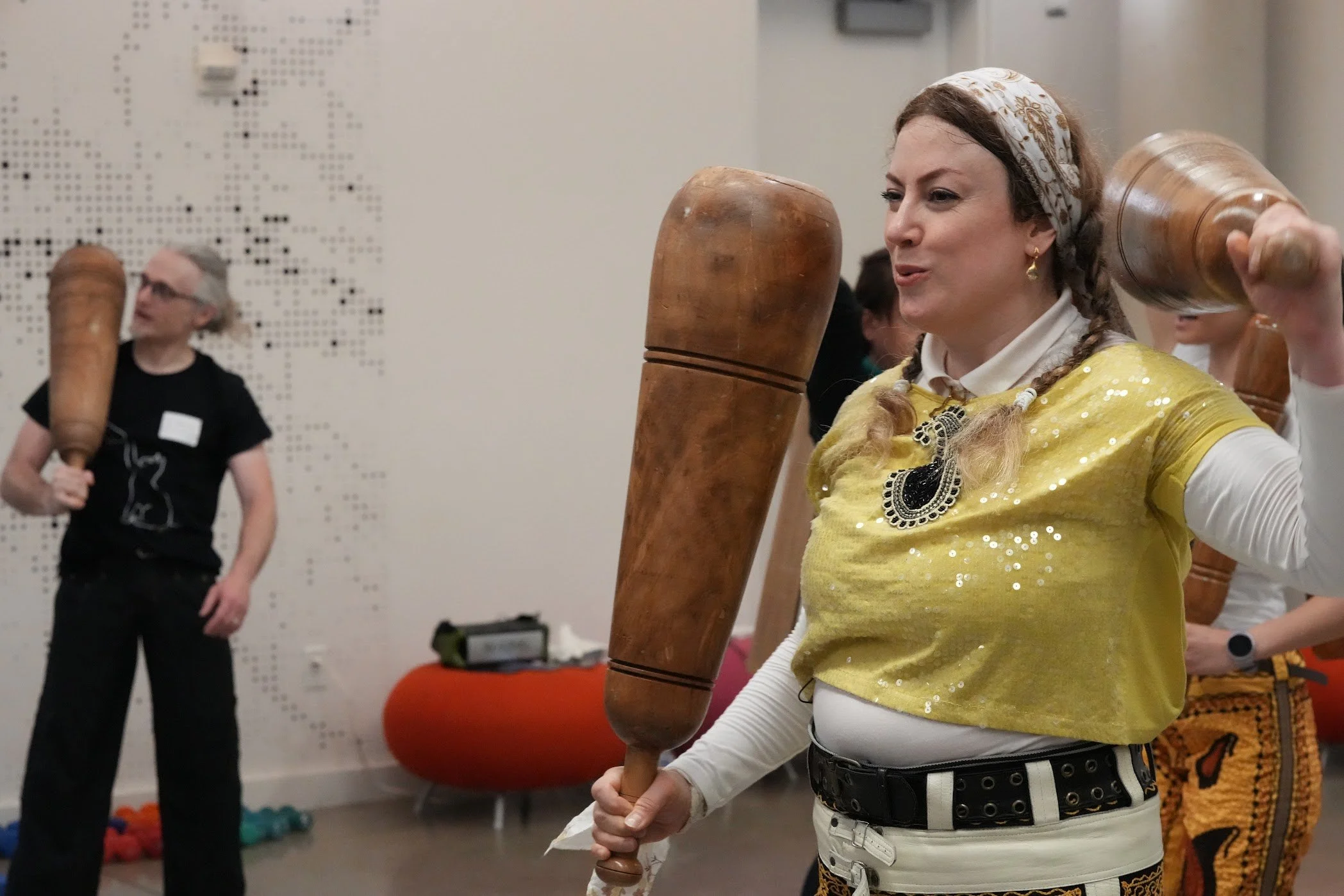
Farnoush teaching the mil swings
Alfred Meza / Courtesy of Sara Modjib Shirazi
We Are Zoorkhaneh hopes to continue building the program and host more events like the Alder Hall workshop and beyond. “Looking ahead,” Sara stated, “We Are Zoorkhaneh is already developing its next edition, scheduled for autumn 2026 in British Columbia. Our long-term ambition is to compete as a recognized team in an international sporting event with a squad that includes women, for the first time in the sport’s recorded history. That aspiration has a significance beyond athletics as it is about redefining tradition and reshaping it for more inclusive identities.”
Now more than ever, traditions like Zoorkhaneh need not only to be preserved, but brought forth into the new age in a wholly accessible way to allow the human connection they provide to flourish. We must come together in unity and solidarity, and we must utilize these tools of cultural bridging to better understand and honor one another.