Perennial Conventions: My Year Without a Smartphone

Green Mountain on Gold Creek Trail
Jordan Ballard-Gennrich
Hello fellow creature,
A sentiment that has crossed my mind many a time in the past few years has been: “I’m running away to live in the woods.” November 2024 had me clawing at the bars of my enclosure like something feral and caged. So from November ‘24 to January ‘25 (the timeframe is highly relevant to my decision) I planned my escape—not from society, but from the very thing that allowed society to access me 24/7. Inauguration Day 2025 marked the beginning of my year without a smartphone and started me on my journey towards digital minimalism. I had to learn to set boundaries with the technology meant to enslave us.
-
-
The purpose of this column is to examine and question societal norms and attitudes gleaned from growing up in the United States. My goal is not to tell people what to do or convince anyone to follow my lifestyle choices for some fucked up semblance of external validation. I simply wish to dream of and live for a different future than the one being mapped out before us.
That being said, Houston—we have a problem. A big one. A WALL-E, I-Robot, Upgrade (2018), style problem. Tech oligarchs are poisoning the earth, water, air, and even our minds. So many people are distracted, dysregulated, and discouraged all by design, myself included. A year without a smartphone provided a perspective that hours spent scrolling through Instagram, YouTube, and checking my emails couldn’t teach me. It was an experiment founded on the hypothesis that this thing,this tool, was making my life harder, not easier.
Additional context: I was never really enveloped in technology growing up. While my peers watched movies and developed the skills needed to play video games beyond button-mashing, I was reading. I did the other things too of course (and this is not a condemnation), but I mostly read. When I got a phone, texting wasn’t an option, so I naturally preferred phone calls. As I grew up, my laptop was used to read unpublished stories on Wattpad, take online quizzes, and read page after page of inspirational quotes or cheesy pickup lines. I often used my Nintendo DS as a flashlight to read under the covers when I was supposed to be sleeping. Still, as an adult I was pulling 8+ hour shifts at the scroll factory, swiping my life away until my hand was sore and my brain was numb.
I decided I had seen enough. There would always be more and it was only getting worse! I couldn’t control much, but my phone’s screen was already giving out and I needed to reclaim some of my agency. Deleting and redownloading apps wasn’t drastic enough.
Enter: The Planning Phase.
Turns out just getting rid of my smartphone was more complicated than I originally guessed. There were logistics to figure out first; namely, as a former military spouse, I had relocated and settled across the country in a state where I had no family and few friends outside of my household. I had a work phone at the time too, so that was an additional device to manage, and my personal laptop was the cheapest Chromebook I could afford circa 2016.
I was brought to my first realization in terms of logistics. My smartphone was basically the center of my life. All my communication, admin, and entertainment stemmed from the same invasive vine. I needed to figure out everything I used it for, then determine appropriate replacements. This would turn my one phone into several different items to serve various purposes. A good portion of these items were stuff I already had, but needed another thing to make it usable again, like CDs with no CD player. Understanding what I utilized personal technology for throughout my life and prioritizing what I needed before getting rid of my phone versus what I could acquire after (secondhand and within a reasonable budget) was Step One.
Eventually, I wanted to make the internet a place again, having come from a childhood where a family computer in the living room rapidly transitioned into individual iPads and tablets. I was banishing myself back to T9 texting on a flip phone for clarity’s sake.
Specifically the HMD Barbie Flip Phone—a pink paradise with a mirrored external screen. It said “Hi Barbie” when turned on and came with a beaded wrist strap, charms, and rhinestones. Even the charger was pink. Nostalgia-bait, hot on the heels of Barbieheimmer summer, arrived packaged prettily in a pink jewelry box. It brought me a lot of joy. It also took me roughly five minutes to send a text and frequently could be found tucked between some couch cushions, because other than a few games and gimmicks, it was advertised for a weekend or digital detox vacation. I was committed to using it full time for as long as possible.
The Flip Phone Experience
I gave everyone in my life a head’s up and there was a bit of an adjustment period. I got lost a lot when driving to new places and eventually received a GPS from my concerned partners. My sister started sending me Instagram reels through email and I even received letters from friends and scheduled times to video chat. The people that wanted to talk to me found a way.
Overall I was giddy, mostly because I was bored. Sitting in silence, driving in silence, making awkward small talk with strangers… it all felt meaningful. I became quite invested in the birds in my neighborhood. I learned about and started my first attempts at “chaos gardening” in our small outdoor space. I was looking at and hearing the world with a novelty I hadn’t expected. This is still true now, but it felt radical in the beginning.
I had dispersed the grip my phone had on my reality and rendered it less powerful. But it wasn’t all birdsong and silence. Outside of getting lost frequently, and the amount of time it took to send a text—which was both a skill and will issue—there were other cons. Without social media or a smartphone, the lack of ease in communication left me out of the loop. That was my goal, of course, but feelings in reality are often different from expectations.
I had to come to terms with the fact that because smartphones were so thoroughly integrated into daily life, not having one was a full-on lifestyle change. It made me different (an experience with which I’m well acquainted). Group chats were a nightmare. Everyone in my life felt as though they were operating at mach speed. QR codes were everywhere and inaccessible without some additional app, which I stubbornly refused to get.
But even as I slowed down and stepped out of the loop, the world was still there—just different. Strangers and friends alike loved the Barbie phone. My sister told her college professor about it. It was a conversation starter/party trick. It was odd, but intriguing. It was a factor proceeding introductions. I even met a few people in the wild that also had the phone!
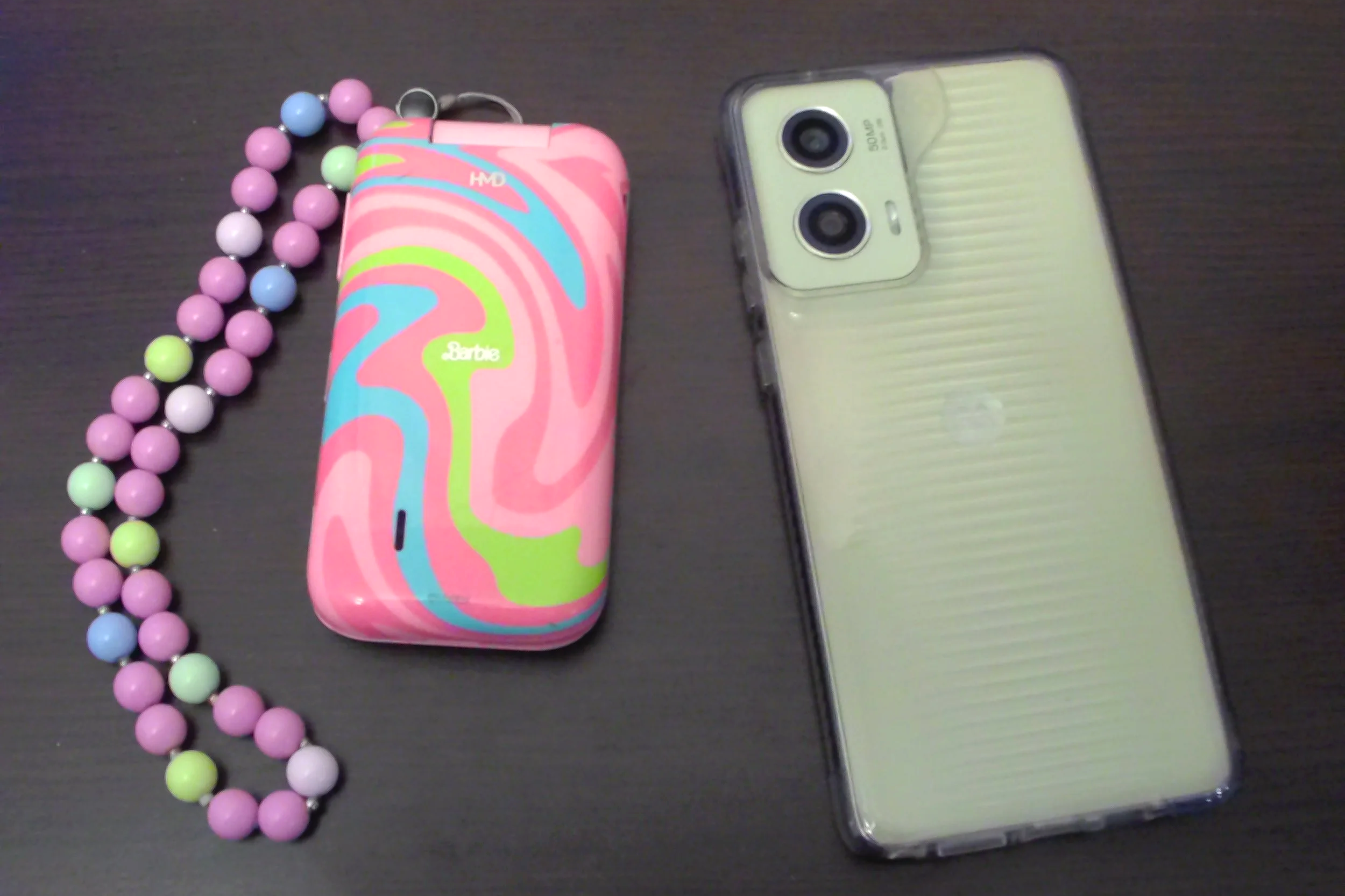
The digital detox Barbie flip phone next to my new (to me) smartphone.
The Evergreen Echo
Experiment’s Conclusion
But all things come to an end. The phone itself was advertised for weekend or vacation use, as a temporary break from your smartphone. It was not meant for daily use and the wear was taking its toll. I missed the abundance of emojis and GIFs, as well as swipe-to-text. So after a year, in January ‘26, I went back to the world of smartphones. A modest, nondescript, slow-to-upgrade phone that used a SIM card (and could switch back to the Barbie phone as a bonus), and was paid in full.
This time, instead of the natural progression of time and technological advancements paving the way, I was going back—or forward—with intention and boundaries, having decentralized my smartphone. I’m still making changes, like opting for physical media and trying to kick my YouTube habit, but progress was made and change was felt.
Throughout my experiment, the accessibility factor was a huge sticking point. A good portion of my life was complicated by my lack of internet access. I can’t stress how many businesses use QR codes for menus, further information on flyers, links to their websites, etc. My kryptonite became QR codes that linked to an Instagram account rather than a website. At one point I printed out the Google directions for a bus route so I could track how many stops I needed to pass. I also couldn’t access banking info, or look up bus or ferry schedules while out and about. It was inconvenient and occasionally impossible to navigate certain situations without the aid of someone with a smartphone.
But the inconvenience was the point. Problem solving, leaning on my community to include well-placed state employees and random strangers, and even accepting that some things weren’t for me to experience or access, challenged and satisfied me in ways that having a phone at the ready didn’t. Life is inconvenient, and the drive to mitigate and streamline for efficiency is the root of some of our society’s most insidious problems.
Pro Tips
Ultimately, since I’ve gone back to having a smartphone, I can feel the power struggle between slipping back into old habits and maintaining my new boundaries. I have to remind myself that the phone is a tool and not the center of the universe. My new phone has an annoying “glance” feature that lights up the screen when I look at it. I combat this by keeping it face down most of the time. I also turn off unimportant notifications and pop-ups that pull focus to the screen. If my phone does something annoying or distracting, I address it immediately so I don’t get used to the disruption.
There are many tips and tricks out there, but I’ve found that the most important element is a mindset shift. Sometimes, if I want to be distracted, I have a game that I’ve been playing for years. With limited lives and a commitment never to engage in mobile game microtransactions, I can only be distracted for a limited amount of time before having to do something else.
In decentralizing my smartphone, I’ve added a journal and planner to my tool kit. The journal is great for getting ideas out of my head and creating to-do lists. I also got a real alarm clock! So I can keep my phone out of my bedroom as needed. The main point is to be intentional with usage. Decide when to use the phone productively, when to use it leisurely, and when not to use it at all.
The mindlessness is the problem, and a lot of money has been thrown at making it as seamless as possible. The more I pull back and analyze the world of personal technology, the more aware I am of all the ways it’s being quietly integrated into systems that don’t need it and bumping out human touches that are sorely missed when gone. And you can bet, I’ve got plenty more to say in that regard!
In the meantime, what’s one thing you use your smartphone for that could be replaced by another item you already own?