‘Sinners’ in the LGBTQIA+ Lens, Part 3: Agency

Cropped Sinners poster with ensemble cast
Courtesy Sinners social media kit
Raegan Ballard-Gennrich (RGB): Agency. Each of the characters display expressions of agency in their sexual lives, lifestyle choices, and engagement with danger and death.
To me, Annie is the embodiment of this. She has to be—throughout the film there are moments revealing a lifetime of disbelief, mockery, fear, and need in relation to her magic. The trust she garners through skillful apothecary work allows her to work for herself in a time where Black Americans of the diaspora had limited options outside of sharecropping and housekeeping.
This assuredness allows Annie to choose her path in life and death. Refusing to become a vampire allows her to join her baby and ancestors in a spiritual plane.
Sinners continuously highlights the power and danger in refusal. This is an underrated technique that women, marginalized races, the Queer and Trans community, and anyone else that the world actively rejects have to learn if they expect to survive—when all options have been systemically stripped from you.
When your voice is not only ignored, but silenced… There is power in saying “No.”

Annie lighting a candle
Courtesy Sinners social media kit
Parker Dean (PD): Annie’s power is ubiquitously strong in the film. She narrates the scene where Sammie shows his musical powers, she realizes what the vampires are, and she helps arm the juke joint against the foes. And through it all she retains her femininity and womanhood. She retains layers comprising her miscarriage, her understanding of magic, her love for Smoke, her cognizance of the world around her, and knowing that the patrons, even if they can’t pay, need a night to live freely. She, more than any character in the movie, seems to understand their purpose at the joint: to exist as themselves, to uplift their people, to honor their culture, and to refuse to bend to the will of white supremacy.
RBG: Refusing to assimilate. Refusing to deny yourself. Refusing entry into your spaces. Refusing harmful ideologies. Refusing to let someone hurt your child. Refusing to believe you are inferior. Refusing to go along simply because “that’s just how it is.” Each character in Sinners represents tactics one might use to counter or combat both “the devil you know and the devil you don’t.” The media (especially social media) depends on its ability to control the narrative. To sell a specific story. They are playing on our emotions, the most lucrative one being fear (or anger which can be triggered as a fear response).
If someone appeals to your vulnerabilities, especially through identity, it is worth being cautious. Do not let Cornbread in until you’ve questioned why he was gone. Why would someone who offers protection be conveniently absent during times of violence and duress? These are the clout chasers, grifters, and people who want to come to the party, but not the rally. Anyone in the LGBTQIA+ community arguing the legitimacy of another identity or weaponizing a lack of nuance to silence experiences unlike their own is just as dangerous to the safety of the group as an outside attack. Refusing could save your life. It could also give you the ability to end your life on your own terms, as shown in Sinners.
Evidence of this was displayed in Grace dying to kill what was once her husband; Pearline backing away from Sammie after being bitten; Delta Slim’s sacrifice; Mary’s rejection of the protection that white-passing afforded her to aid and be with the Black community that she loves; and Annie and the Twins in every way that they live their lives. The all too traumatizing lesson that Sammie learns is that agency and choice (especially against all odds) might sometimes be the last choice you get to have.
At this moment we are facing attacks from all sides in every community, and it is up to us to say no to the erosion of democracy. Say no to the administration's attempts to disenfranchise voters by targeting the Trans community. To the stripping away of hard-fought rights for women, as we enter yet another war where women and children are disproportionately impacted by violence. Say no to demonizing your neighbor, as ICE sows fear and chaos while targeting, without due process, American citizens and people who came here for the “better life” we sold through propaganda. Say no to hate and division.
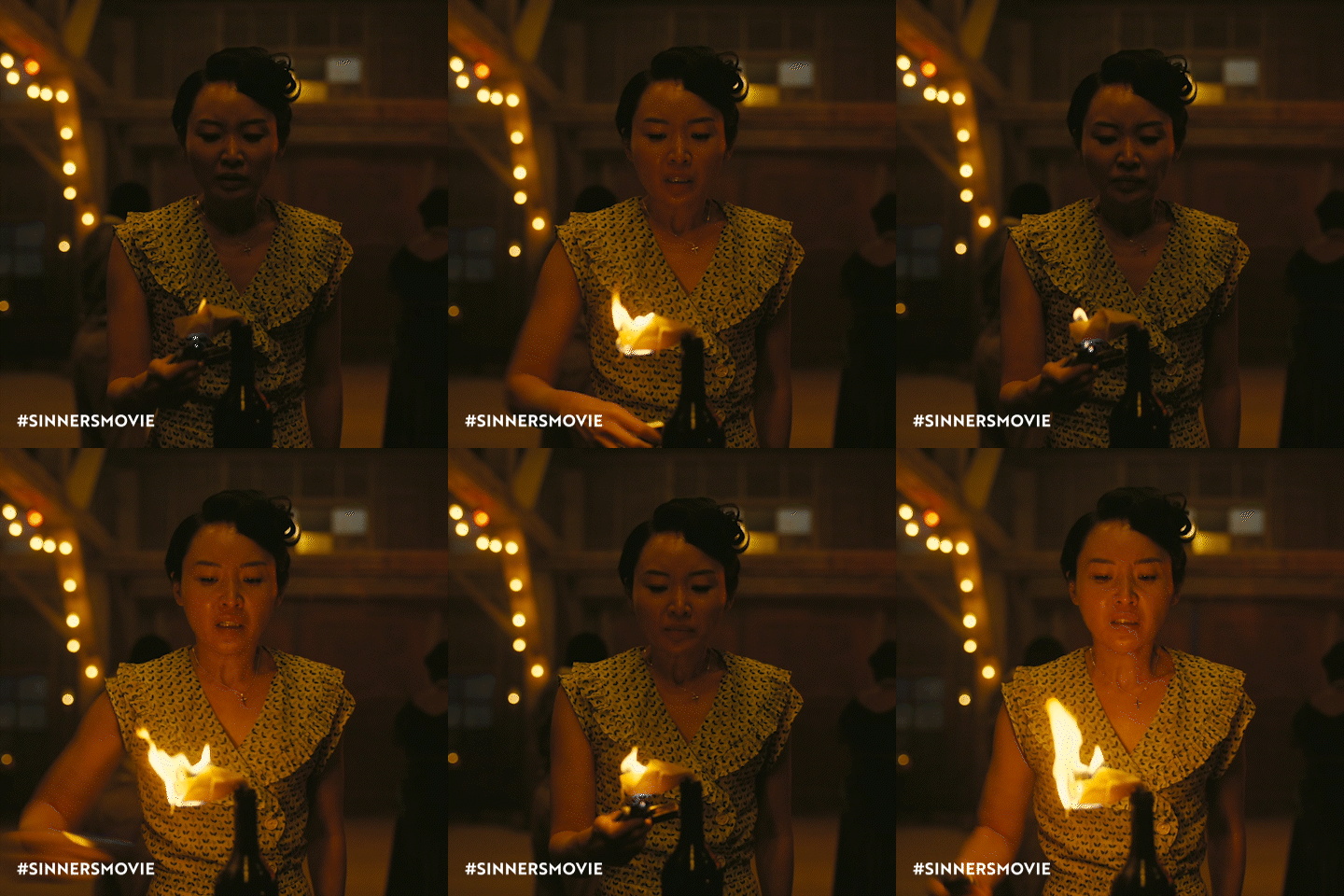
Grace lighting a Molotov cocktail
Courtesy Sinners social media kit
PD: I remember how the movie theater cheered in that near-final scene where Smoke takes matters into his own hands, killing the KKK members that came to the juke joint to kill him. This was a huge display of agency—Smoke choosing to die in a way that saves so many others, confronting death knowing that he would find Annie and his baby, and fighting for what was just. He also chose not to kill the vampiric version of Stack, honoring their love above everything.
RBG: Sinners has a lot to say, but one of the takeaways I thought was particularly poignant for our current time is this: From the moment we are born our brain is like a sponge, soaking up our experience of the world through senses, emotions, and all the ways the world interacts with us back. And with that knowledge, many try to mold us into a version of ourselves that suits them best. Governments, other nations, parents, media, peers, strangers online, your boss. Hell, marketing is an entire field dedicated to finding the best way to manipulate us into spending our money, time, and attention somewhere or on something specific. And the only choice we really have complete agency over—the only choice that people want to take away entirely—is the ability to say “No.”
The world is full of power imbalances, like the constantly rejected and the never rejected. To some, a rejection is an offense so great it’s punishable by death. And if that is the case, sometimes the only strength you have is showing them that death is preferred to complete subjugation.
Sinners is a masterpiece. There are several lenses through which one can analyze the film due to its absolute grasp on intersectionality. But I believe it also gives us the key, a truth so self-evident that it could be a relation to the human spirit itself. A truth that people will go to great lengths to obfuscate. You can say no. And sometimes you must. But most importantly, it is up to you to figure out when that is. For me, it has always been every time injustice rears its ugly head and goes for the jugular.
What say you?