Parker’s Pages: Dungeon Crawler Carl
The Evergreen Echo
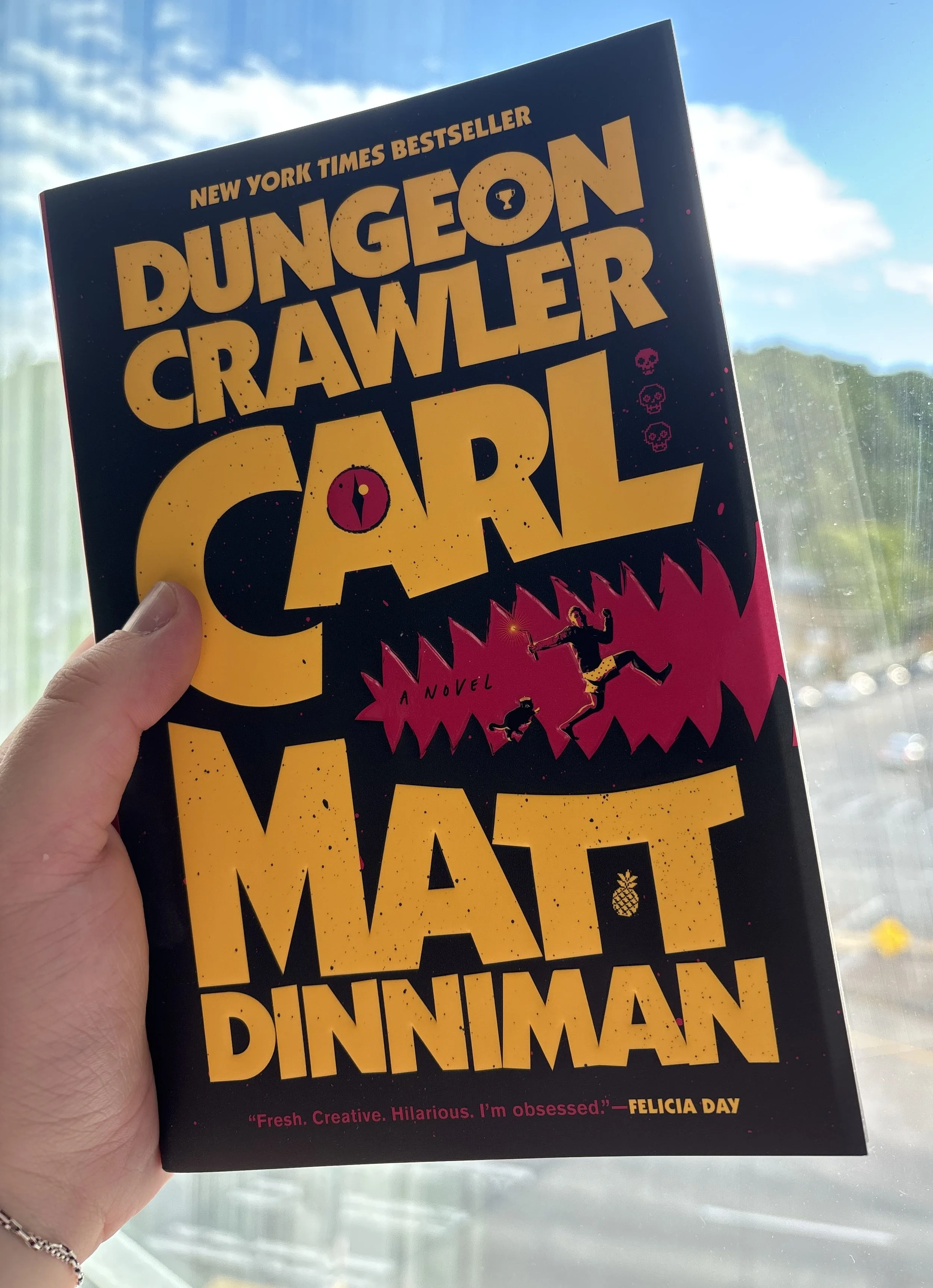
Like clockwork, whenever I share what I do here at the Echo, specifically with this column, I am told that I must read and review Dungeon Crawler Carl by Matt Dinniman, a Puget Sound native and fantasy and sci-fi novelist. I must admit, it was the title that most intrigued me. I’d certainly played my own dungeon crawler once or twice, and I liked that there seemed to be humor and absurdism baked right into the title. So, after a long wait, I’m happy to announce I have finally cracked open the first book of this 8-book series (with two more on the way), and I am obsessed.
This novel opens similarly to one of my favorites ever, The Hitchhiker’s Guide to the Galaxy by Douglas Adams, in which the main character discovers that Earth has been sold and used by an alien corporation. Though, in Dinniman’s version, Earth has not been completely destroyed yet. Instead, the humans and other creatures who survived the initial arrival of the aliens are made to take part in an 18-level dungeon crawler, complete with user interfaces and head’s-up displays, health bars, inventories with unique items, skill trees, and various buffs and debuffs. Initially, the rules of this dungeon crawler game feels complicated and heavy-handed, but like a real video game, the rules and the world-building become clearer over time. I ended up appreciating that Dinniman opens the novel with heavy world-building, as it sets up the reader for the rest of the story and gives us an insight into the overwhelming feeling that the protagonist feels too.
We follow Carl, a former Navy Coast Guard and down-on-his-luck homebody, and his ex-girlfriend’s cat, Princess Donut, as they explore this new world and wrestle with the sudden and immediate change that they must fight through or die. With Carl as a vehicle, the world opens up to the absurd, silly, and interesting. Because Carl begins the story with a seemingly unflappable and go-with-the-flow attitude, it helps the reader approach the setting with the same attitude. I also adore Carl’s feline companion. After receiving a special item in the first level of the dungeon, Donut gains the ability to speak. She is a charismatic and funny character throughout the rest of the story. She is also surprisingly complex and offers a balance to Carl’s character. Carl is naturally a little more laid back, but Donut is more driven. In the dungeon, this means that Donut is the one driving them towards success while Carl acts as her bodyguard. This dynamic is hilarious to watch unfold, but also, quite simply works.
Because there are a lot of books in this series, and a lot of world building to explain, I won’t be focusing too much on the plot. Rather, I wanted to share something that I learned from reading this book. Because I had never read a book quite like this one, where a normal world is so suddenly flipped into something fantastical and game-like, I went on to explore this genre deeper.
Make it stand out
Whatever it is, the way you tell your story online can make all the difference.
LitRPG (Literary Role-Playing Games) is a modern literary genre, where fantasy and science fiction elements are mixed with the elements of classic computer Role-Playing Games (think Baldur’s Gate, the Dragon Age series, or Cyberpunk—or in the case of Dungeon Crawlers, games like Arx Fatalis or The Binding of Isaac). This means mixing classic literary ingredients, like complex characters, plot structure, and detailed settings, with those game elements—skills, character leveling, health bars, or settings which appear like game levels. More examples of LitRPG include Ready Player One or the He Who Fights with Monsters series. Funnily enough, most lists of LitRPG station Dungeon Crawler Carl right up top, cementing it as one of the best examples of the genre.
But there’s more! I discovered (down my LitRPG rabbit hole) that there’s an even broader term for any novels that feature game-like elements. This is Game Lit—broadly, any story that features a game-like setting. The video game RPG setting is obviously a contemporary concept, but there are some older novels that can be boxed into Game Lit. My favorite example is Jumanji. While you’re probably most familiar with the 1995 movie, featuring the late, great Robin Williams (or its revival movies in 2017 and 2019 with Dwayne Johnson, Jack Black, Kevin Hart, and Karen Gillian), the original series is an illustrated children’s book from 1981. The book, which has the same plot of characters discovering a board game that slowly begins to come alive, is Game Lit to a ‘t.’
I, and many of my Puget Sound friends, highly recommend Dungeon Crawler Carl to you, and the timing for diving into the novel is excellent, as a short live-action television series is currently in development for the series. An 8-book series is certainly a time commitment and may seem daunting, but this novel really does fly by; the pacing is quick and digestible, and I will be taking my own crack at it (maybe a second Dungeon Crawler Carl book will pop up in this column one day!).