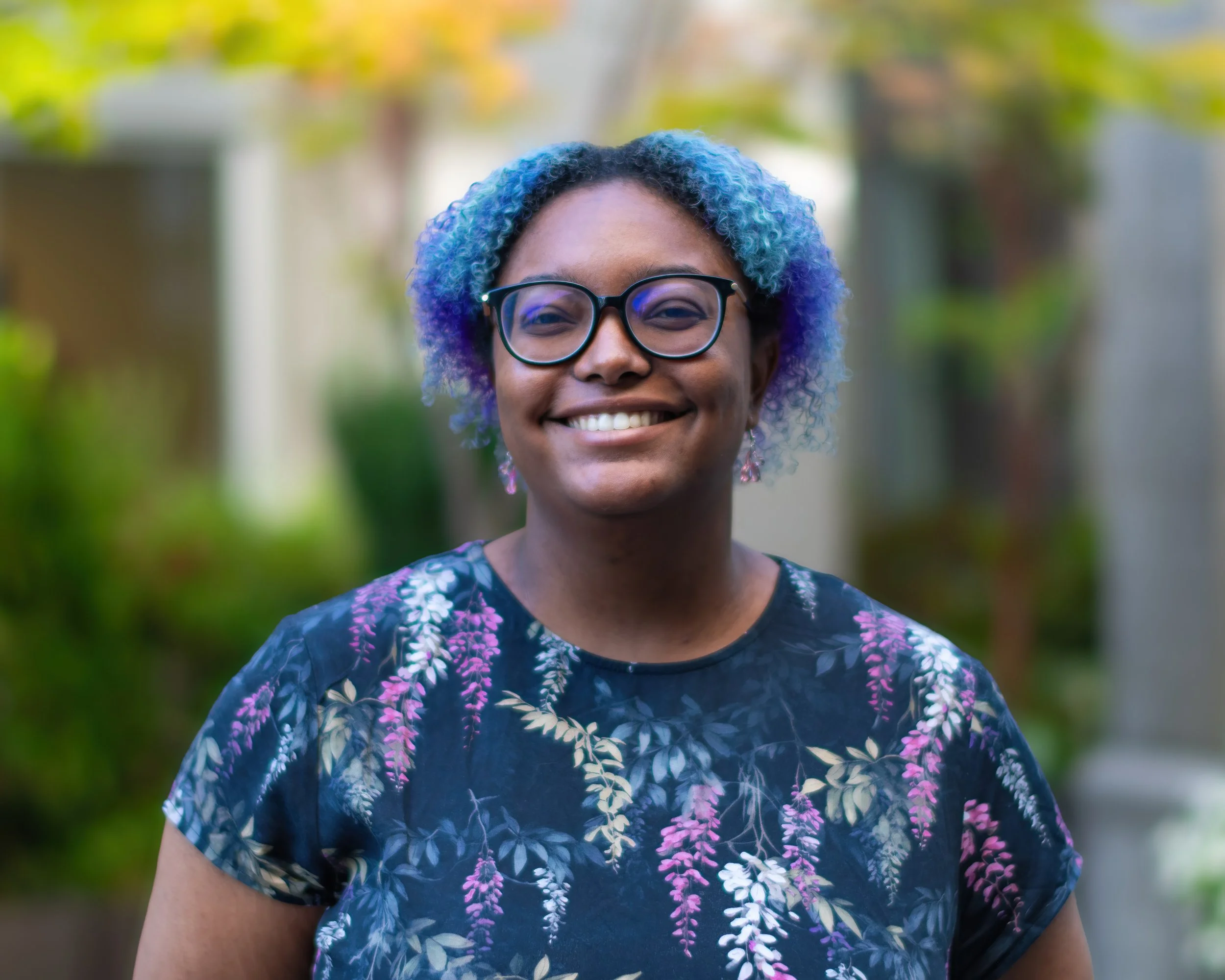
Mike Barnet of Brmrtn Blk Mkt Creates Hub of Black Community
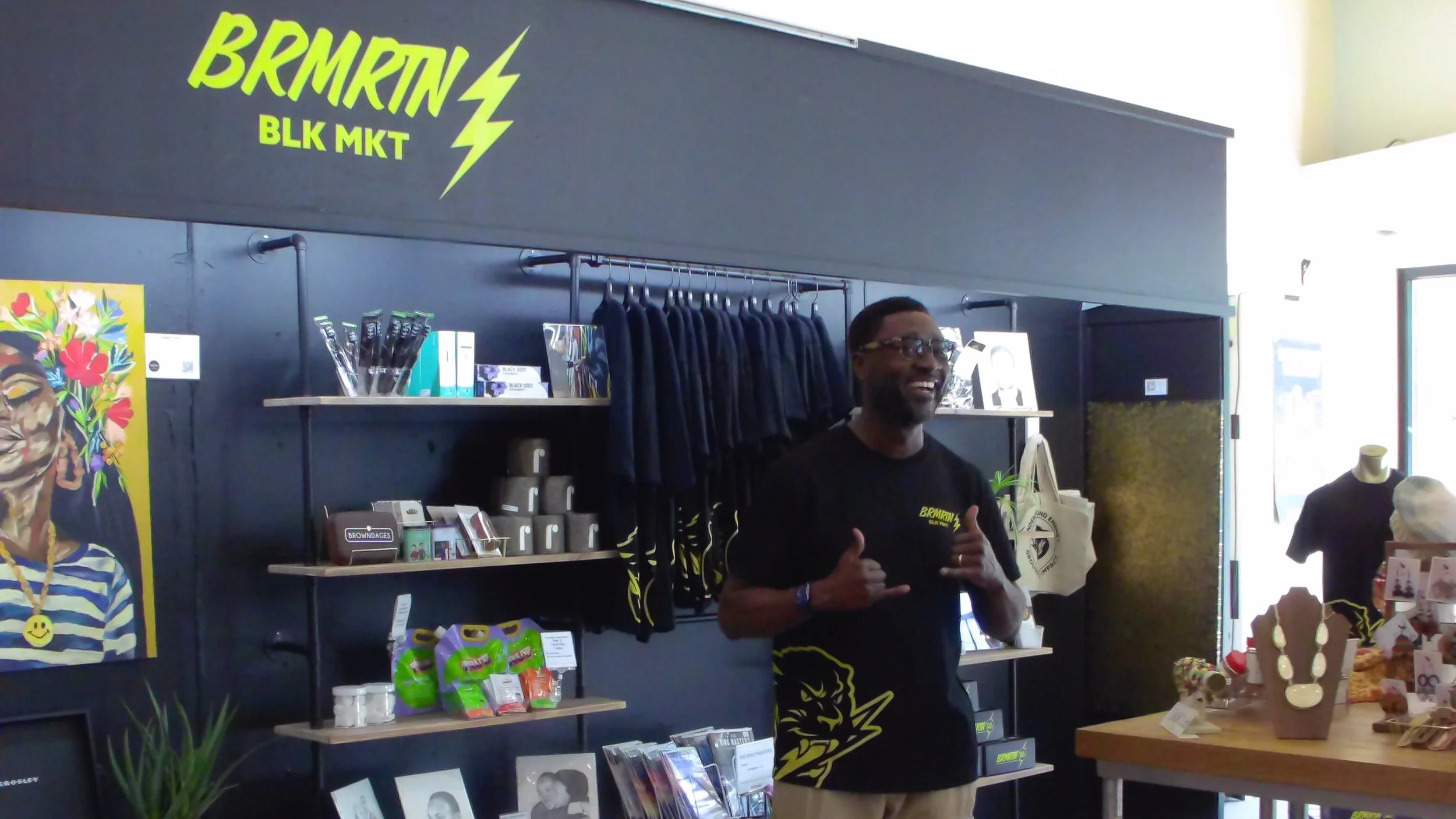
Mike Barnet of Brmrtn Blk Mkt
The Evergreen Echo
Early in May, I had the pleasure of attending an event called Brmrtn Blk Mkt (Bremerton Black Market). It took place in Downtown Bremerton’s Quincy Square and per the website was “an open-air market celebration in Quincy Square of Black-led businesses, food vendors, doubledutch performances and live entertainment!” This free market allowed me to engage with and support my cultural community and I left, purchase-laden, feeling invigorated and refilled.
Since moving to Washington, I’ve braced myself for the increased number of times I’ve entered a room and been the only person who looked like me. Even if the faces were friendly, there was an automatic otherness. An acknowledgement of a world and space not designed with me in mind. A realization that I wasn’t just an individual, but consciously or not, I became a representation in other’s eyes. Walking into Quincy Square presented me with something I hadn’t realized I missed so much. Community, and the safety that came with it. I knew I was welcome.
While shopping at the market, my investigative hat was on. Locating the featured booth of the organizer, I found the queue waiting to talk to the person who made it happen. With a brief pitch, I left with contact information and a plan to explore the how, why, and what’s next after this event. My efforts and text messages allowed me a sit-down conversation with Mike Barnet.
Mike Barnet (he/him) was the organizer of the Bremerton Black Market event as well as the founder of Brmrtn Blk Mkt, the online and temporary pop-up shop located downtown, which featured some of the same vendors from BBM and operated as a curated community space and consignment shop.
Mike grew up in Silverdale, at a time when the small town had just opened the mall. Adopted into a white family, he grew up with 5-6 other Black families around. With his love of skateboarding and punk music, he found his way to California for college. Eventually returning to his hometown having spent years as a musician, followed by TV and film school, working on MTV, Viacom, and Wheel of Time, he settled into his day job at Bremerton Kitsap Access Television (BKAT), our local TV station.
We sat in the space curated for Black comfort, the furniture borrowed from the home of him and his wife, Dominique. The walls were decorated with art from a local Black artist (whose prints have made their way into my home as well), the air filled with a scent from a local candlemaker, tables and shelves held products from Black vendors, and clothes from their son’s fashion line were in the room. Even the soft music playing in the background of our conversation featured Black artists.
I started with the burning question: What was the motivation behind organizing the market? Mike explained that it started as an art experiment. He wanted to encourage Black entrepreneurs, but more importantly, he wanted to show how easy it could be. If he could just start with no business savvy, with a mind towards artistic curation of vendors rather than profit margins, and with a goal of amplifying local businesses, then anybody could do the same.
In terms of motivation, a few things came up in our discussion. He wanted a local effort based around supporting neighbors rather than shareholders. Through the lens of a curator, he wanted to show appreciation and love for “kooky” Black art. To shift focus towards being innovative about business. He thought that us “Black nerds” were going to save us (the community) with the ability to see things from different perspectives, read people, and have empathy.
We discussed the challenges of growing up on the margins of our own community—having interests that were attributed to dominant white culture, but were often rooted in Black culture prior to popularization. The struggle of being relegated to a monolith, struggling to find one’s place within your community as well as within the greater community as a whole. And of possibly being rejected by both. This led to an understanding that we need to find ways to strengthen community, to accept the different ways of being Black, establish an economic focus, try to keep money within the cultural community, and to look towards a future of Black-led hospitals, banks, everything. Not as a means of segregation, but to have spaces that are Black-forward.
We talked about the effects of representation or the lack thereof and how that heavily impacts outcomes. How even minimal representation greatly shifted prospective outcomes in teaching, and the burgeoning research in health outcomes are already underway.
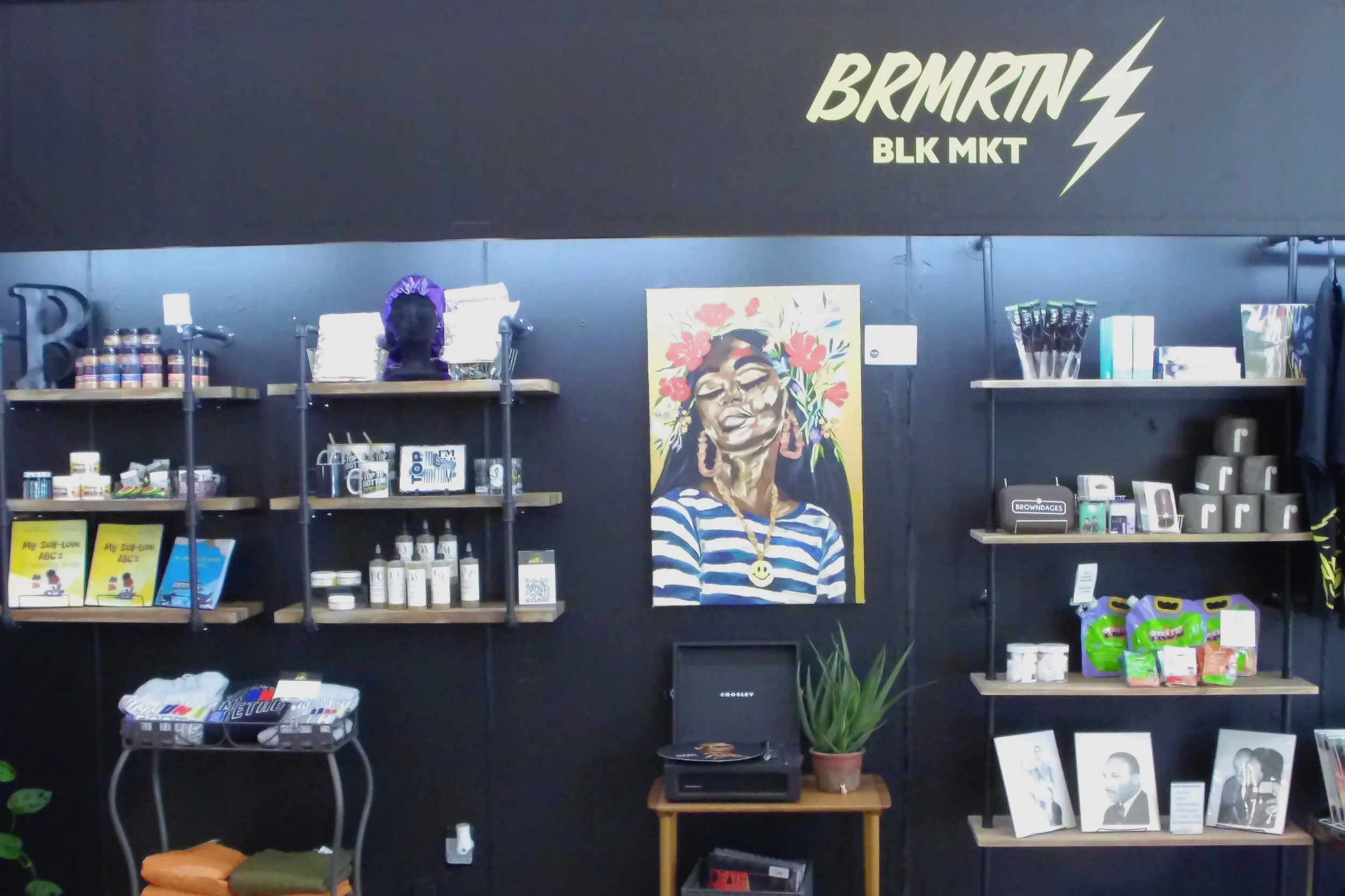
Wall at the Mkt
The Evergreen Echo
The philosophy behind the market is that Black people also need culturally specific spaces. The efforts to politicize and racialize everything Black have gone a long way in negating the cultural American identity that other cultures engage with. He pointed out that there was a Mediterranean Market also located in downtown Bremerton. Asian, Hispanic, Scandinavian, Jewish, etc. communities all had markets and stores all over America, and while other cultures and communities were welcome to enter and engage, the spaces were centered on the comfort of a specific community. Black people deserve the same comfort. Even swapping out just a few essentials for Black-owned products could afford our community the financial power historically denied to us.
Our conversation switched towards the less positive aspects of this mindset shift: the historic destruction of towns and financial institutions built by and for Black people, such as The Tulsa Massacre and Black Wall Street. The systemic redlining and denial of access to business loans or grants, and even to this day lawsuits are brought against organizations that promote health equity for Black patients. But, through our conversation, we highlighted the successes of Tulsa group-economics, how bartering, trading, crowdsourcing, and other creative methods made financial success possible. And, in regards to facing potential obstacles in the present day, how the internet provides so many avenues to circumvent roadblocks and gain necessary information.
We also discussed the Target boycott, emphasizing the dangers of false corporate acceptance. Which led to briefly touching on the current internet discourse surrounding a Black boycott of Asian businesses in response to comments made after the adjudication of a shop owner’s murder of a Black teen.
Mike expressed: “[There] needs to be a code. A mindset shift towards a movement versus a rebellion. Not to boycott other cultures but to put us first.” He also described the movement as “Not a rebellion, but a recognition that we need to take action.” Instead of reactions based on perceived betrayals or corporate disrespect, we needed to seek better conditions, leveraging our economic power with dignity. An acknowledgement that segregation created the understanding that the products, business, and resources of other communities were better and we were left trying to prove we were worthy of the same and could participate. This mindset only served to further the agenda of white supremacy.
-
We as citizens of a nation that claims to be democratic should be voting not just with our ballots in local, state, and federal elections, but also daily with our dollars. Because comfort and the false belief that the people attempting to extrude every modicum of labor and time from us somehow also have our best interests at heart is keeping us disadvantaged. Support local businesses within and without your cultural community and vote, so that when corporations go bankrupt due to their poor labor practices and egregious values, there is no government bailout available to save them.
Black economic power is not a rebellion or a boycott. It is a movement in which we center ourselves as the first option. An investment into our own community and our right to circulate our dollar where we see fit. The choice to shop local within our greater communities instead of corporate. In my opinion, just look at how the billionaires move to make themselves and each other rich. They leverage money to affect societal and political change, which tells us that we should be able to do the same.
Mike Barnet’s first market turned out well. The vibes were good, and his motivation: “to be kind to Black people, to create a space for kindness and ease,” was, as a person who attended, well executed. Seeing the excitement was the greatest part of the experiment and the outcome was, as he said, “If it can be, it can be.”
Getting out in front exposes doubts and Mike stressed the importance of not wanting to be or needing a single leader, but rather encouraging the community to build as a whole, to replicate his success as a blueprint. He was left with excitement and hope that finding more ways to grow economically, maybe bringing in music, pop art, and highlighting our punk history. Looking towards the future he mentioned that a Blk Mkt Christmas would be great, undoubtedly featuring Blanta (Black Santa), and many more possible events and community discussions.
In final thoughts, Mike shared that perhaps the community most disadvantaged by capitalism could reimagine a better version. A more beneficial, more inclusive version that we could work towards. Using these hard times to be joyful and steering that creativity towards financial problem solving. When approaching business through an artist’s mindset over a business mindset, the focus becomes human-forward, rather than profit-focused. Which is something we sorely need.
I can’t wait to see what we (my people) do next!