Trans* Talk: It’s Never Too Late
The Evergreen Echo
It’s almost Spooky Season. As my nerdy Queer friends will tell you, Spooky Season does in fact begin in August, which means that I have spent some time rewatching a few of my favorite scary movies. I am a bit of a wimp, so my roster includes much lighter horrors like Coraline (2009) and Ghostbusters (1984). But one of my newest obsessions is I Saw the TV Glow, a psychological horror and drama directed by nonbinary filmmaker, Jane Schoenbrun.
I Saw the TV Glow debuted in 2024. I watched it that October in the basement of a friend’s family house. We had dimmed the lights, popped popcorn, and cozied up on a rainy PNW evening. I remember how the film shook me to the core, not exactly because it was scary, but because I felt seen by it. The suffocating fear of the movie had washed over us completely; we even had to stop midway through for an ice cream break because we were both so emotional.
We talked about the movie for hours afterwards, staying up late to fully dissect it from the colors to the word choices to the actors’ performances. I even dreamt of the movie that night. I could not get out of my head.
Cut to a few months later. The movie had a boom of popularity in online spaces, especially on Tumblr. I was seeing pages-long posts analyzing the film, gifsets showing parallels between different scenes, and people creating comics and images based on the feature. But despite the love the film was getting online, I was also seeing a confusing trend. There were so many people who did not seem to get the film at all. They wondered why it was being praised when they did not find it particularly scary or the story particularly compelling. They did not seem to pick up on the themes or metaphors that seemed obvious to me, and these people were often cis and/or straight.
I was baffled. It felt like they had watched a completely different movie than I did. How did they not feel the crushing weight of it all? This film was about staying in the closet, suffocating, being left behind, being alone in your identity, and the discomfort that comes with not feeling that you are who/where you are supposed to be. What was there not to get?
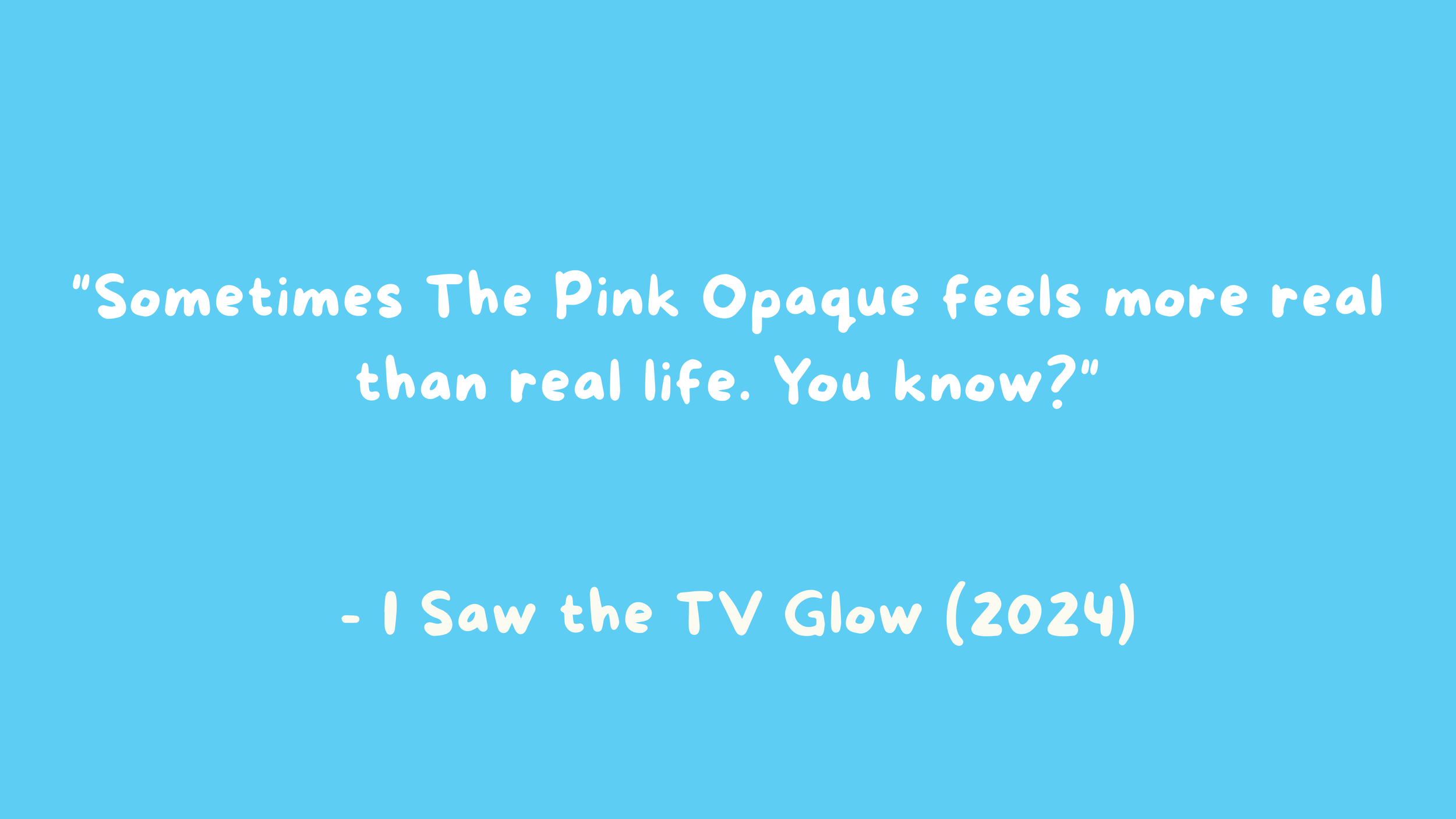
The main character, Owen (Justice Smith), meets an upperclassman at his high school, Maddy (Jack Haven). They both share a love for a late-night TV show called The Pink Opaque, a Buffy-esque monster hunter show featuring two girls who share supernatural abilities and connect to each other psychically.
Over time, Maddy begins to speak about the show as though it is real, and claims that she and Owen are both actually the main girls, Tara and Isabel, from the show, placed into an alternate reality by an evil entity. She urges Owen to come back with her into the TV show so they can save the world there, but Owen refuses her. The movie ends with Owen, years later, in a dead-end job at an arcade with a wife and children, screaming for help at work while no one looks at or hears him. It is devastating.
The Evergreen Echo
I figured out that I was Trans when I was 15, but I didn’t pursue much in the way of social or medical transition until nearly a decade later. Today, I am out and loud about it, and I have been on testosterone for about 2.5 years. I speak very openly about my transition and my Queerness, as it flavors and fills so much of my life. But even though I figured out who I was at a young age and began the bulk of my transition in my early twenties, I still often worry that I missed out on formative years being afraid of medical transition and harboring internalized transphobia. I often wondered if I should have begun earlier, if there are things I missed out on by waiting.
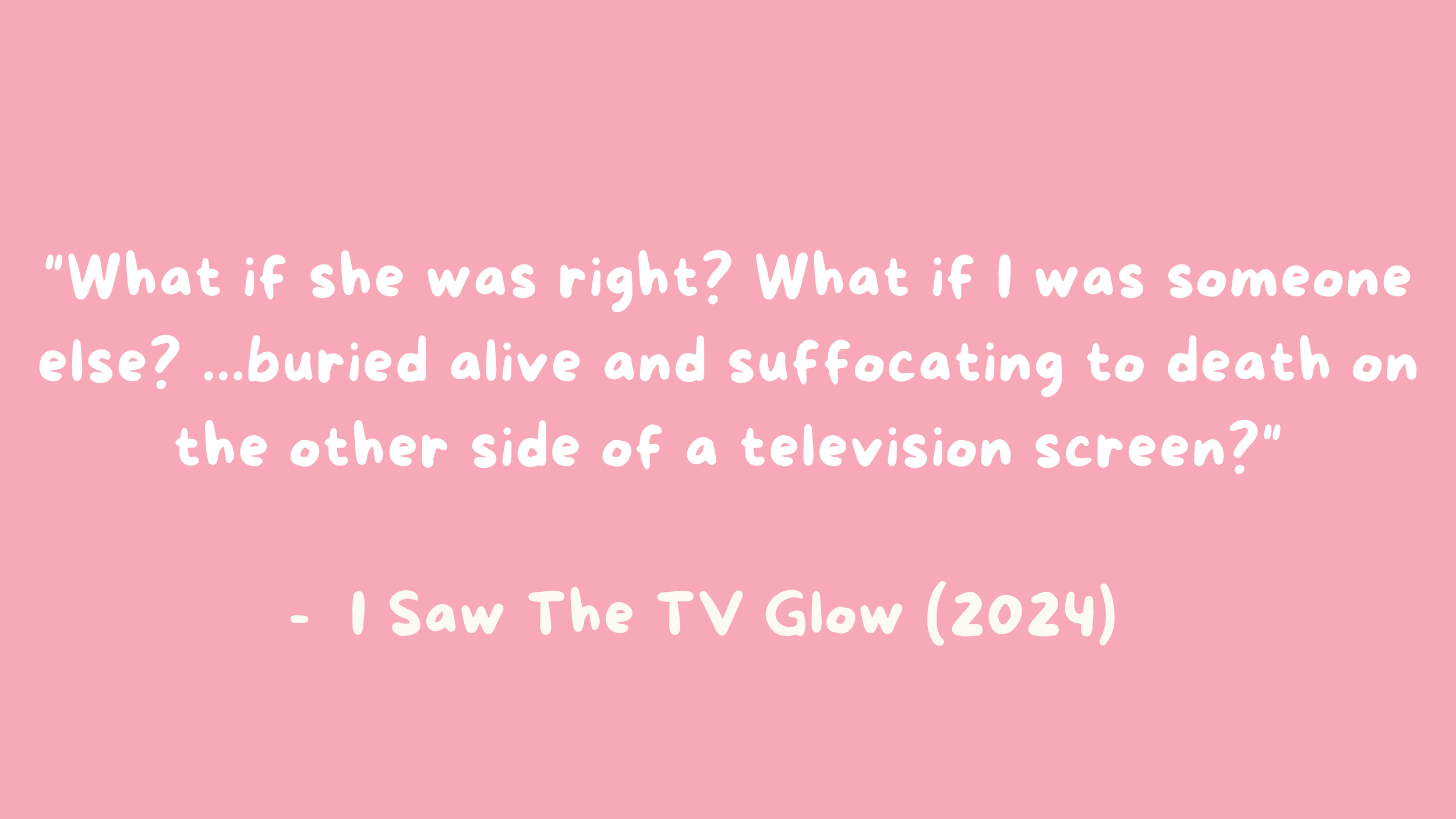
That suffocation—knowing that there is something different about you, that you do not fit in your body—is something I am intimately familiar with and something that the movie recreated within me. Owen is torn between believing Maddy’s claim that he is actually the girl in The Pink Opaque and not wanting to disrupt the status quo. One of the titular scenes is Owen trying to shove his head into the TV, sparks and color flying around him, until his abusive father pulls him out and back into “the real world.” The pain of the film is in how Owen pushes away The Pink Opaque and Maddy, how he lives his life without the color of the show—and how he continues on as a man—even knowing that this whole other life is out there that he could be living. The horror is realizing that Owen feels disconnected from this free, Queer world, and that he feels it is too late to get to that world by the end of the film.
The movie’s message is twofold: 1. Don’t ignore the feeling that there may be a better world out there, and 2. It is never too late.
Trans folks have existed throughout history, but so many of us were forced into hiding due to societal pressure, laws that threatened to eliminate us, and fear. But we existed, we exist now, and we will exist forever. And it is never too late to become who you are. Among various communities, Trans folks are coming out and transitioning later in life as we build connections with each other. People in their 30s, 40s, 50s, even 80s are finding themselves.
The Evergreen Echo
This week I want to encourage you to watch I Saw the TV Glow, but I also want to remind you that it is never too late. Experiment with your hair and clothes, and do not fear that you’re too old to begin exploring your gender or sexuality. There is no timeframe for becoming who you are, and just because someone started earlier or knew who they were earlier does not mean that your connection with transition or Queerness is any less valid or important. While a piece of me wished for so long that I had been able to transition sooner, I now feel grateful that I waited until I was in a safe place with a safe community, and that I gave myself the grace and time to figure things out without rushing into something that scared me. I am also grateful for the perspective of my Trans elders and for people whose transition differs from mine.
The Pink Opaque might be a made-up TV show in a made-up movie, but there is something real about it to me. I hope that all Trans and Queer folks are able to live in their own Pink Opaque, as the person that they want to be and admire.