
Lessons from Venezuela: Working Class Solidarity vs. Imperialist Violence
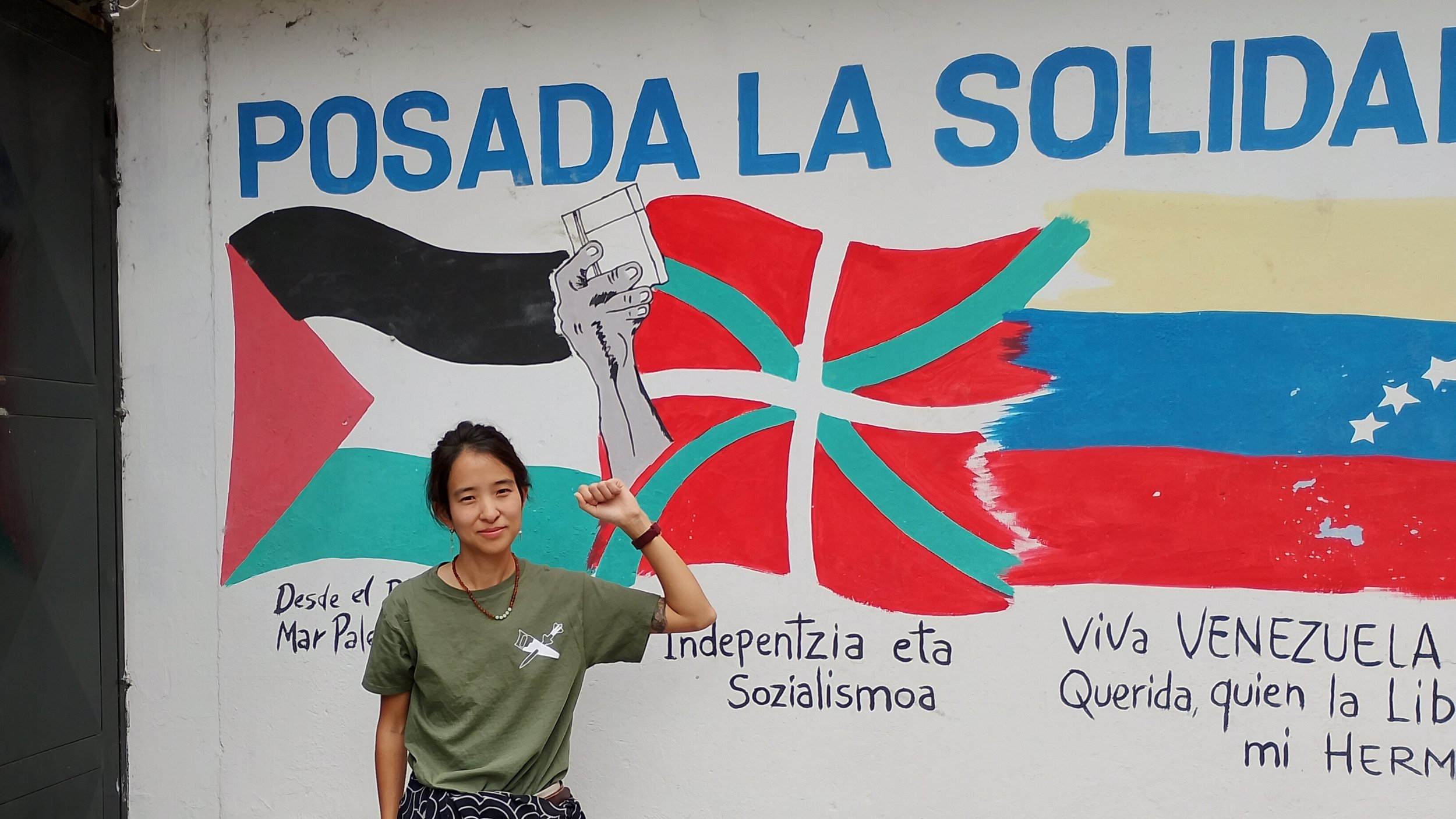
Rae Lee in front of a painted wall of solidarity with three flags
Courtesy of Rae Lee
When orbiting leftist circles in Seattle, serendipitous collisions become commonplace. Rae Lee is a regular at my workplace, a friend of a friend, and an anti-imperialist organizer. Given the US’ January attack on Venezuela’s sovereignty, I became curious about Rae’s recent trip there in early December, convened by Simón Bolivar Institute for Peace and Solidarity Among Peoples.
Even as someone who sees themselves as clear-eyed in regards to propaganda, I was struggling to wade through the differing opinions on the political situation in Venezuela. Chiefly, I pondered: Was President Maduro at the helm of an oppressive totalitarian state that betrayed the values of the Bolivarian Revolution? How can we in the US identify and amplify the truth for the Venezuelan people?
Really, the only way to know was to talk to someone who was there.
Kristel Chua (KC): First, can you introduce yourself?
Rae Lee (RL): My name is Rae Lee. My pronouns are they/them. I am the current chair of Seattle Against War (SAW), which is a member organization of the anti-war action network. I am also a member of Freedom Road Socialist Organization (FRSO).
KC: What work do you do?
RL: SAW is a grassroots anti-imperial organization based in Seattle that aims to wage a relentless struggle against the US war machine…One of the greatest purveyors of violence in the world is US imperialism, [which may look like] economic sanctions, troops on the ground, interventions in sovereign governance. The kidnapping of Maduro, the ways that [the US] provides Israel with material support, these are manifestations of the US war machine...In our own country, we don’t have democratic control over what happens with our tax dollars. We want to build people’s movements to show that we can do something about this [and] exert pressure on strategic points and weaknesses.
Our current campaign target is Representative Adam Smith. He sits on the House Armed Services Committee [and makes] a lot of these decisions with our tax dollars. He’s rubber-stamping them as they cross his desk, but he’s not getting any heat for it. He presents himself as this progressive, democratic politician, but he’s a career politician. When we look at his voting record, there has not been a war that he hasn’t supported. Now, what he’s trying to do is say, “What Trump is doing is too blatant, too overt. Let’s tone it down, guys.”
KC: Even though he’s still complicit.
RL: 96% percent of his campaign funding is coming from Palantir, General Dynamics, General Atomics, Microsoft, Boeing, and AIPAC. We are trying to expose him… He should be working for us...When we try to bring constituents’ concerns to him, he’s slippery. He pretends he has no power or control, but we see right through him.
KC: To turn to our main topic, what led you to go to Venezuela?
RL: This was in early December [2025]. I went as a representative of the Anti-War Action Network to the People’s Assembly for Sovereignty and Peace in Our Americas. The US delegation [consisted of] a mix of various organizations...but because of the declaration of the No-Fly Zone, many flights were canceled. Initially there was about 50 people in the US delegation. Only 10 of us made it through.
KC: Could you describe the situation regarding the No-Fly Zone?
RL: For the US to declare the No-Fly Zone, it is an act of war. Thousands of people from all over the world were coming to attend this conference [but] because of the No-Fly Zone and cancellation of these flights, [we had] a thinner attendance. These are tools used to intimidate, coerce, and shut down acts of solidarity, things that should be within Venezuelan’s rights as a sovereign nation. The fact that we made it through as a delegation, it meant a lot. The people we met were so glad to have us there and thanked us for taking that risk. We were prepared to not be able to come back, for consequences. [Venezuelans] recognize that our own government is not representing our interests. They are in solidarity with us, too.
KC: What was your experience in Venezuela? Especially, what was your experience of the economic state?
RL: How many housing projects that they’ve been able to accomplish under sanctions using their model of [socialist-oriented] governance is impressive...You can see it. It wasn’t, “wow, so shiny,” but you can see, even under immense pressure, they’ve done a remarkable job housing people. Which, you know, who are we to talk?
KC: We aren’t very good at housing people, no.
RL: We visited a commune, El Panal, an urban commune in the working class neighborhood in outlying Caracas, a site of resistance since the ‘60s...Even before the communes were formalized into law in 2006, they [already practiced] a certain level of self-governance, democratic decisionmaking. When Hugo Chavez visited, he said, “this is the future of Venezuela.” [Chavez] was able to realize this vision through state revolutionary reforms.
[El Panal] has social enterprises like a garment workshop, [and] the profits towards investments that they democratically decide on. There’s a sugar packing plant that’s being turned into a meat processing plant. There’s a swimming pool that, during the pandemic, they turned into aquaculture farms...They get state funding [to] actualize their own means of production...to get to a point where they don’t need that state funding because they’re self-sufficient.
One thing I wanted to share, because I’ve heard stories of Venezuelan communes that are misrepresentations: it’s not decentralized and autonomous communes. They are coordinated, networked with each other. The state recognizes it as a critical part of the socialist growth. Maduro said the goal was to get to 70,000 communes. Right now they have 40,000 communes...[this] proves that they’re actively carrying out the Bolivarian Revolution and beats back the propaganda that [Venezuela is] an authoritarian regime. We cannot even imagine the level of democratic participation that they are able to exercise. They also have these national consultations that started in 2024 [that] President Maduro helped initialize.
KC: Say they wanted to vote to turn a swimming pool into an aquaculture. What does that process look like?
RL: That is actually happening at the commune level. They have communal councils that meet every week. The projects at the national consultation, that’s massive infrastructure projects [such as an] overhaul of their entire utilities system…because that’s what it takes, a level of infrastructure development that can quickly develop a nation. [The national consultations] happen multiple times a year. Now, even without President Maduro, it is continuing. It's incredible.
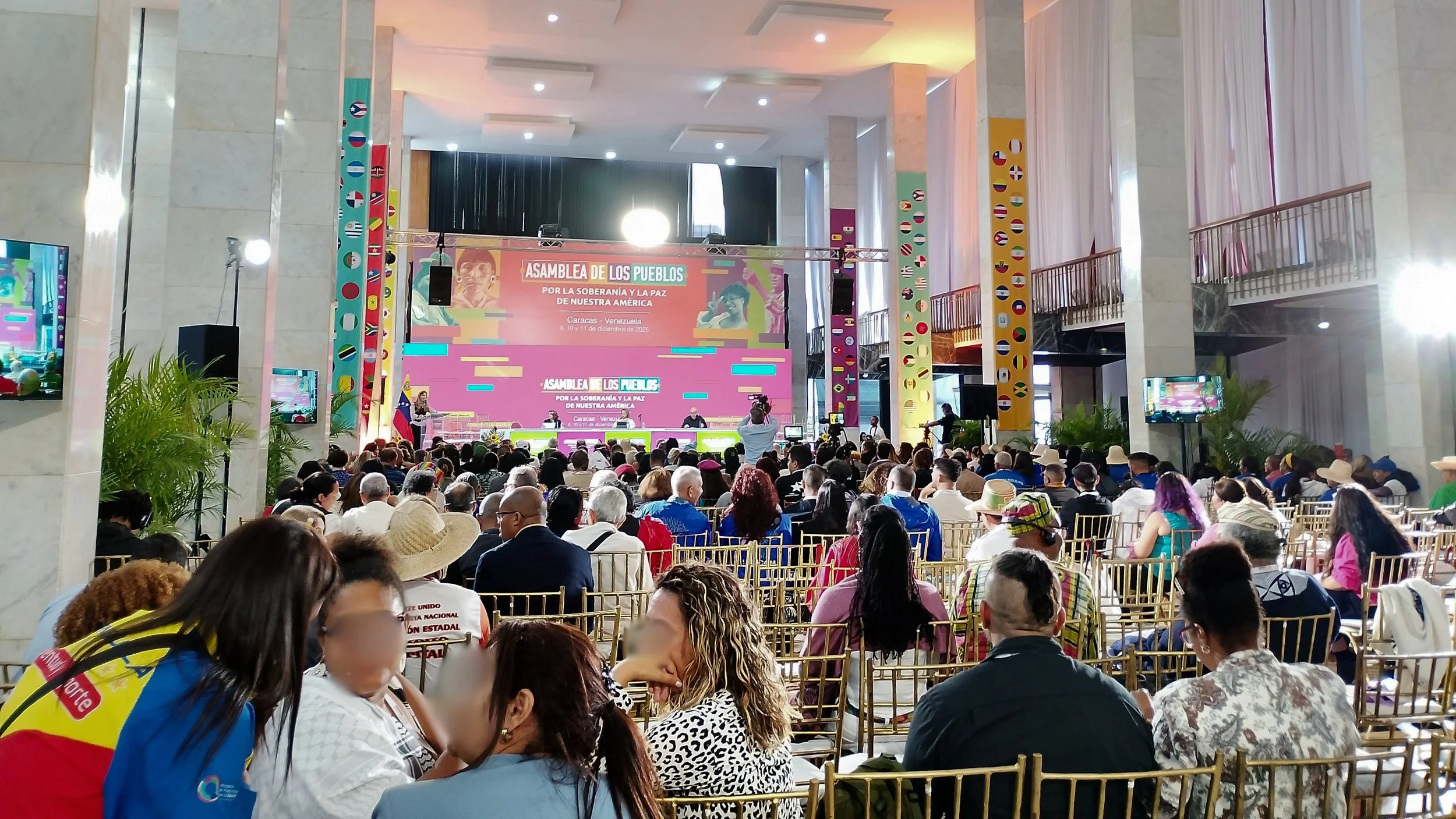
Audience at People’s Assembly for Sovereignty and Peace in Our Americas, Caracas 2025
Courtesy of Rae Lee
KC: Pretty much anyone can attend?
RL: 10% of the population are organized into communes—that’s huge. Voter registration is really high. We hear all the propaganda about rigged elections, but have you seen what it involves? There’s biometrics, full auditing, which the opposition party is also a part of. Venezuela has a whole ministry formed just for election accountability. The head of that is approved by the national assembly. We [in the US] cannot throw stones.
KC: Not from our glass houses.
RL: We even meddled in their 2024 elections with cyber-attacks…despite that, it was one of the most transparent elections ever [in Venezuela]. When there are these attempts to disparage the sovereignty of nations that are standing against the US empire, we need to be sharp in our understanding of how much of what we are hearing is already coming through a filter. It wasn’t until I was on the ground in Venezuela and talking to people that I was able to combat what I grew up learning.
KC: What about the narrative that a lot of liberals and leftists say, like, “Maduro was a bad leader, it was an authoritative state?”
RL: When I was in La Communa Amila Vaca, we saw President Maduro. He was there as part of a rally celebrating the wins of the councils a part of that commune. He was having [the councils] stand up and acknowledged them for all that they’ve done to develop their district. He [shared their] national plan for the next year. [It was] transparent bilateral communication. He toured their facilities which included a game room, a pharmacy, housing development...Amila Vaca even has the manufacturing capacity for sanitation materials, a big pain point during the COVID-19 crisis. Maduro had no security with him. The people were mobbing him, giving him their babies…There’s a trust between him and the people and the people and him that you cannot deny. He’s a very popular president. He was a bus driver, a representation of the working class movement. As soon as you start looking at what he’s said and done, the “authoritarian dictator” narrative falls apart… [The US] is under an undemocratic, increasingly fascistic “regime.” But Americans never use the word for their own government.
KC: So your overall impression of Venezuela was a country flourishing?
RL: It is a resilient country. It’s hard to overstate the importance of Venezuelan oil as the basis of their economy… It’s the foundation for their ability to trade in dollars and purchase things to import. But they’ve been trying to divest that economy and develop their own infrastructure for food sovereignty... It takes a long time. Now that we’ve got the Venezuelans into a choke-hold, it’s even harder... We have done everything possible to sabotage countries relying on a different mode of production.
It is important for us to ask: What could Venezuela be had we not choked it under decades of coercive measures including sabotaging political leadership, sanction? Who is the source of the violence? It is US sanctions that underlie the source of much of the suffering of Venezuela for literally years and years…Some organizers do not like using the word sanctions because it doesn’t convey the violence of it. You are choking the life out of the country. Using these underhanded coercive measures to have people die, and people do die… We don’t consider that in the same way of directly bombing people. I think it’s very cowardly…[In Venezeula] people suffered.
It wasn’t easy to rapidly build infrastructure when you don’t have access to raw materials. It requires so much collaboration, collective effort…[When I visited] what I saw was their confidence to outlast this US aggression. You can’t fake that. Something I heard at the conference: “It’s the Bolivarian Revolution or death.” If they don’t band together and resist US imperialism, the US will suffocate the Americas. In order for there to be collective safety, there has to be collective risk. That was a strong theme, this need for solidarity and regional unity for any nation to survive under the imperial aggression. Unity or death. Communes or death.
KC: They acknowledge the risk they are facing.
RL: You don’t get to sit on the sidelines. We can say that about our current fight domestically. There’s a lot of people who think they can sit this out, but they’re coming for all of us...If we don’t do something drastic, we are heading towards a cliff. This is a fight to the death. I’m not seeing that level of urgency here, but when I was in Venezuela, I did. And it’s not just desperation, it’s joy. It is a fierce joy and a fierce pride that each and every one of them is carrying out the Bolivarian Revolution. It is something beautiful.
KC: What was the reaction from you and your contacts in Venezuela when President Maduro was abducted? That happened shortly after you returned.
RL: It is absurd, brazen, and absolutely unacceptable that we are normalizing this. We immediately reached out to our friends and checked in...They were in shock. 100 people were killed by that “precision strike.”...We have a moral responsibility to name it for exactly what it is.
KC: What are Venezuelans doing to fight back?
RL: They’re very steadfast. They [are building] international pressure to release Maduro and all political prisoners. At the same time, life goes on. The Bolivarian Revolution [is being] taken up by ordinary working class people. That work doesn’t stop. There’s thousands in the streets… But 70% of the media there is [controlled by] opposition forces [funded by] the US. People are not immune to propaganda. At the conference, we talked about how we are in a hybrid state of warfare. It’s not only about military build-up or direct bombings and attacks. It’s a fight for the narrative control of reality.
KC: What can we do now?
RL: Right now, we’re not mustering the level of outrage and public pressure to end it. But by linking struggles together, showing that Palestine is connected to Venezuela, connected to Cuba, connected to possible intervention with Iran, connected to ICE’s violence…[SAW is building] a powerful broad movement. I’ve met people at anti-ICE protests that are like “Why are we chanting for Palestine?” Wake up! [All of this] is being done with our own labor and our own tax dollars. We have a special duty to put a stop to this.
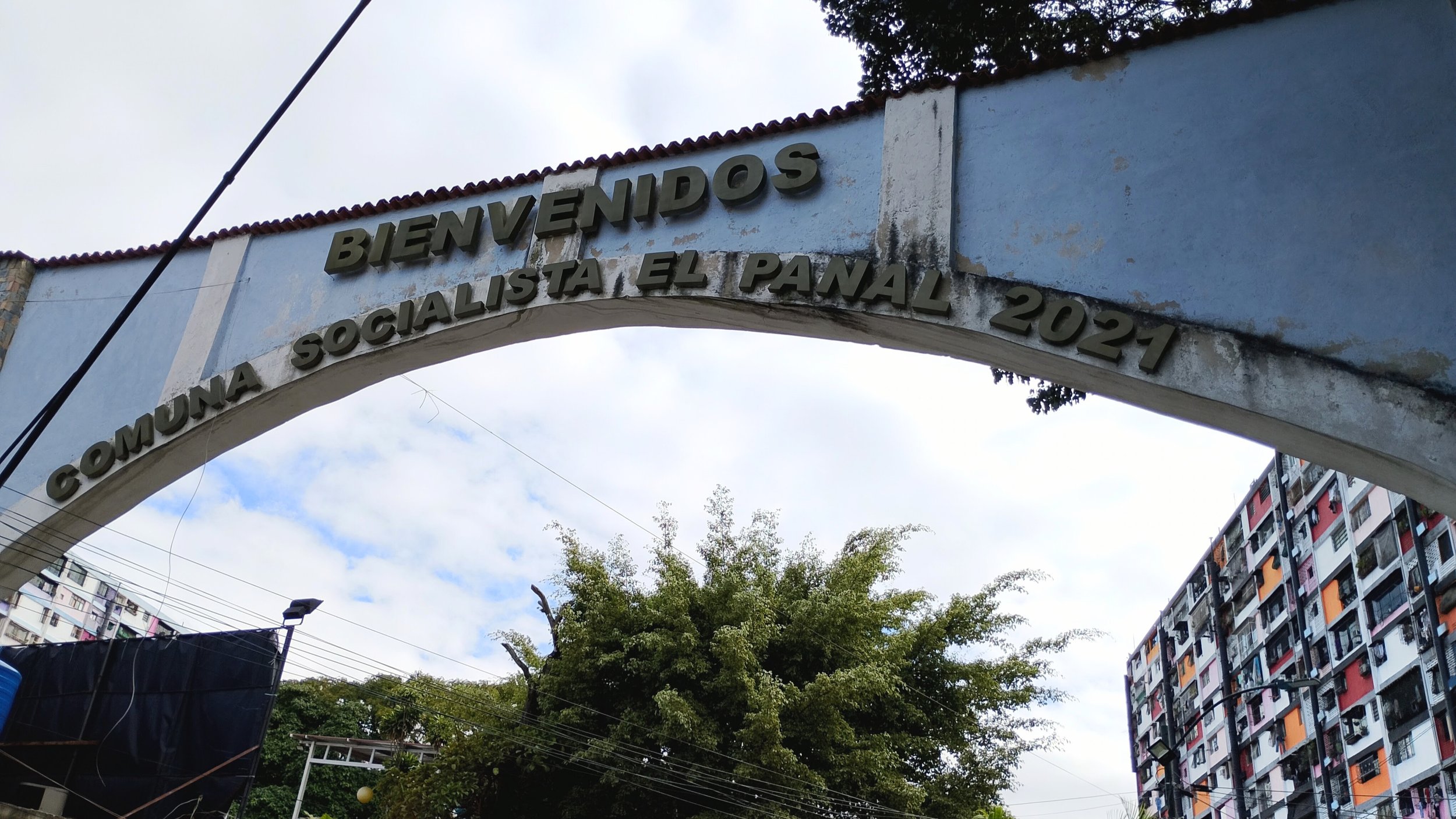
Archway into the El Panal commune
Courtesy of Rae Lee
KC: Do you have a specific message you want to convey?
RL: For people who say, “I don’t know what I can do, I feel helpless…” I’m telling you, when you join a struggle…that sense of helplessness goes away, that transforms your mindset. I feel so much more alive. I feel so much more connected to the liberation movements of the world, to people. It’s a great antidote for the sense of alienation and hopelessness...[When visiting Venezuela], I was reminded that there is a fierceness that is necessary... Here, we don’t have that, that clarity is missing.
When we recognize this as a life or death struggle, when we bring that clarity [to] our shared enemy, then we can build a really powerful movement. It’s easy to get stuck in disagreements of ideas. It’s much more powerful and necessary to unite in action. I cannot drive that home enough… Our job is to end US aggression, end US sanctions, stop the flow of material support to the genocidal attacks.
Armed with knowledge and experience, FRSO and SAW continue to build, rally, and educate. Though national focus has of late shifted towards domestic ICE terror, it is of utmost importance to address the cause of that particular symptom—migration forced by the economic pressures of US imperialism. Dismantling the US’ systematic destabilization of other countries is the best way to ensure that oppressed people across the globe can live secure, dignified livelihoods. And the first step towards confronting the state is to cut through the bullshit and seek the truth: That after all, we in the US can afford to learn something from Venezuela’s revolutionary resilience.
To learn more or get involved with FRSO and SAW, follow their social media pages: @frso_seattle and @seattleagainstwar.
