
Jordan Ballard-Gennrich
Hello fellow creature,
One of the things I’ve often struggled with, and with increasing difficulty as I’ve aged, is the fact that I felt clearly born into the middle of something. I had to learn, adapt, and adjust at every turn in the hopes of figuring out what on earth (quite literally) was going on!? I was born in the middle of a society, in the middle of a state, in a country, in a system. In the middle of my parent’s lives, a lineage in progress. The more time passes, the more I feel as though I’m freaking out about Time itself. And not specifically its passing, or the practical experiencing of it, but rather the concept and the way humanity seems fear-driven to grapple it into submission or die trying.
Time, at the core of our existence, drives everything we experience and more. For there to be a beginning, there must be time. We’ve deified it. Measured it. Our lives seem consumed by our need to track, race, defeat, and extend it. We’ve commodified it, converting our prescribed measurements into dollars and cents. How much is your labor worth? In a skills-based society that’s part of the equation. I once worked for someone who scheduled their day in 10-minute increments. But in our time-based existence, our time is worth something. Priceless outside of capitalism, it becomes a question of how much is an hour of your time? How much is a year?
-
Time - Eva Hoffman
-
“Landslide” - Fleetwood Mac
“Time in a Bottle” - Jim Croce
-
Arrival (2016)
Click (2006)
i woke up at 5am for a week to read about time - the secret society
The Cult of Busyness: How Overworking Controls Your Mind - Knitting Cult Lady
Did Ancient Humans Live Outside of Time? - Ben Rosenberg
-
TED: Ideas change everything - Carl Honoré
Some determine this figure for themselves. Others spend their entire lives trying to convince others it is worth anything at all. Corporations increasingly target our attention; not content to wait for the conversion of our money, they’ve set their sights on our time itself. At one point, brand marketing focused on giving us back time, to make life easier—the washing machine, for example, promised time back to women laboring at home, but what actually followed were higher expectations, and more tasks filled that time instead. AI offers similar false promises. Now companies like Netflix openly admit that the only thing they're competing against is our need to sleep. And the thing companies (usually tech) gloss over is how much time is spent learning how to use their products, troubleshooting them, and building them into existing schedules. Instead of selling us things to give us more time (theoretically), they are selling us time fillers, vying against our responsibilities and even our biological needs for our increasingly limited “free” or leisure time.
There are of course cultures that experience and process time differently. And a lot of theories about how time would move differently through space. Even our human past has references to time and various studies have been dedicated to its effects on our psyche. We’ve also invented new terminology to better understand the effects of our aim to manage our time down to the nanosecond.
I consider myself to be a person prone to a seemingly perpetual state of existential crisis (read: chronic depression). I’m not surprised that I’ve taken until this past year to examine time with curiosity. After an extended stint of unemployment, my sense of time has reverted to the nebulous markings of night into day into night as my nocturnal proclivity plays tug-o-war with our diurnal society. One of the beautiful aspects of our progressively interconnected world via the internet is the ability to find likeminded people who’ve struggled with experiences or concepts regardless of culture or time period. So I began my quest.
This quest, like most, began before I knew it had started. I’ve been questioning a lot of societal expectations and norms (the purpose of this column) in the midst of desperately needing to cobble together some sort of schedule for myself that rejects the hustle-based, eternal growth mindset that’s burning everyone out and ruining our planet. I also have the misfortune (as a matter of perception) of experiencing time blindness. As a Black American it can be said with familiarity or condemnation that I run on CP Time, a feature of my general desire to remain unhurried, especially for no reason and a large contributor to most of my external anxiety.
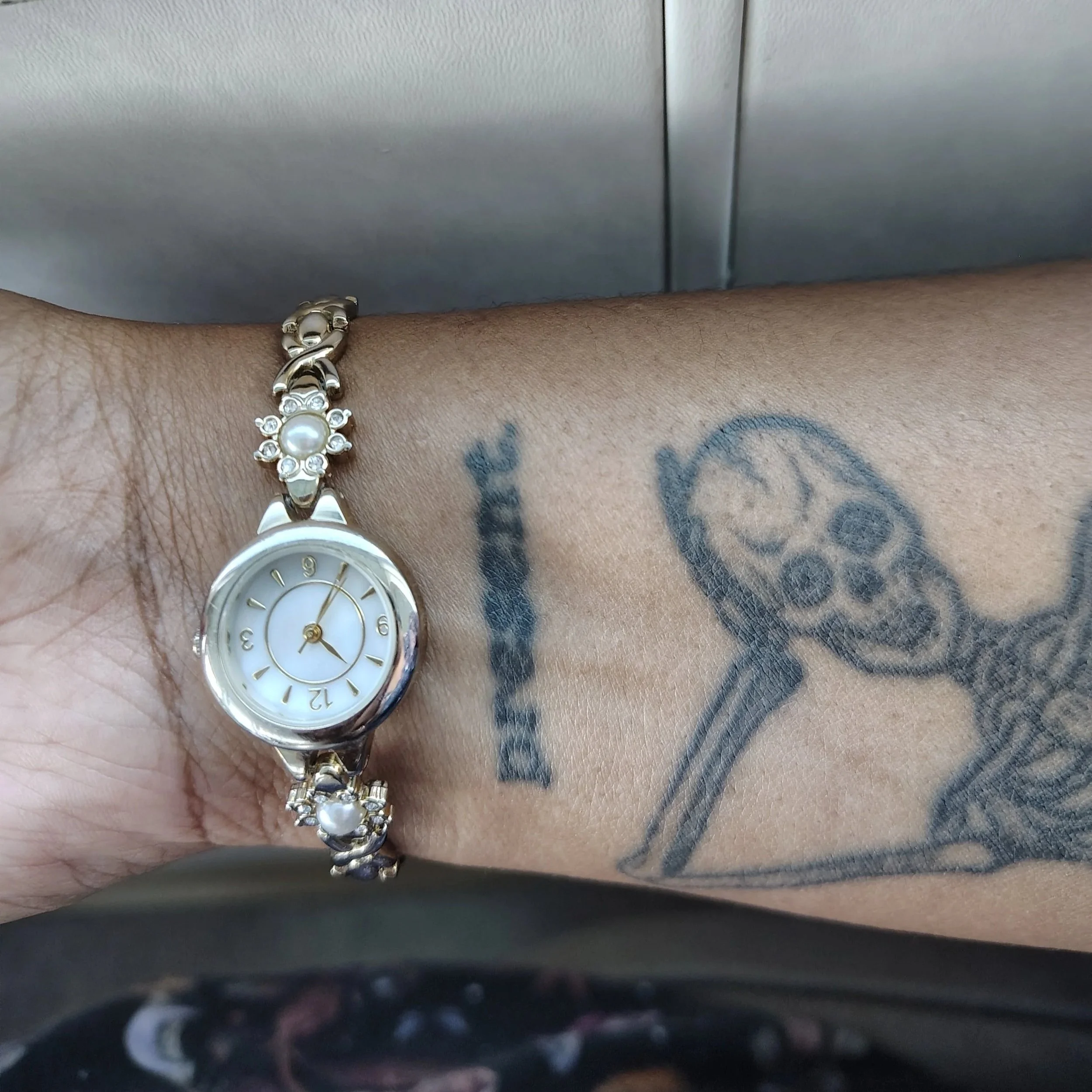
My purposely upside-down watch │
The Evergreen Echo
I, however, still have a great many things I want to get done in my lifetime and so began, intentionally, my rabbit-hole quest to examine how I use/spend/pass my time and how I can understand it on an individual and societal level. Through my reading I was able to learn of The International Slow Movement—a cultural movement pushing back on the speed and immediacy of everything in our lives. Just another example of how I’m not alone in this.
I went searching through the selections at my local library to see if I could find a book to use as a launching point. Enter: Time by Eva Hoffman. Eva Hoffman is a Polish-born writer who wrote Time as a philosophical look into the culture and experience of it. Hoffman seems to share similarities with my thoughts regarding the concept and the book provided a lot of insight into the cultural, societal, historical, and physiological impacts that time has wrought. In working through the book, I allowed my mind to enter into a discussion, of sorts, which has led to taking in most media through a literary filter of time. The urgency of romance, the pacing within a film, the temporal elements of grief—the more I see it, the more life revolves around it.
When I was trying to build a schedule, the ease at which our algorithms tip into efficiency, consumerism, or efficiency by way of consumerism is also rather evident. Too much of the advice was geared towards productivity for the sake of itself. In the introduction of Time, Hoffman touches on sentiments that feel particularly American:
“It was not only that time moved faster in America—it pressed onwards in more stressful ways. People worked much harder, of course; but also, it seemed to me, more anxiously. I was witnessing, even if I did not initially realise it, the phenomenon of “American nervousness” which had been a trope of social commentaries ever since the end of the nineteenth century.”
She adds later: “—everyone suffered from the stress of not doing enough, or the possibility of doing more, or at least feeling good and guilty about it.” (Hoffman, p. 5-6)
Ultimately, in a 4-section breakdown she covers time and the body, time and the mind, time and culture, and time in our time. As both an enjoyable and informative read, it covers a lot of the questions I’ve been asking myself and my quest for understanding has been greatly aided. It also brought comfort through informing me that I wasn’t alone, and a great many chronophobiacs were out there, and writing as well, and it served as an excellent jumping off point into my study of sentiments around time.
Yet, there are additional questions, such as how time relates to my specific cultural identity, time as it relates to disability and aging, and humanity’s destructive hunt for immortality. Perhaps the ‘be careful what you wish for’ trope in media is less about your wish being different (read: worse), more than you bargained for, what you least expected, or not what you actually wanted. Maybe it’s about the temporality. Click (2006) tried to make this point, I believe—the wish becomes a cosmic punishment for instant gratification. The innate rejection of wanting to have the result of a lived experience without accepting the cost. The passage of time.
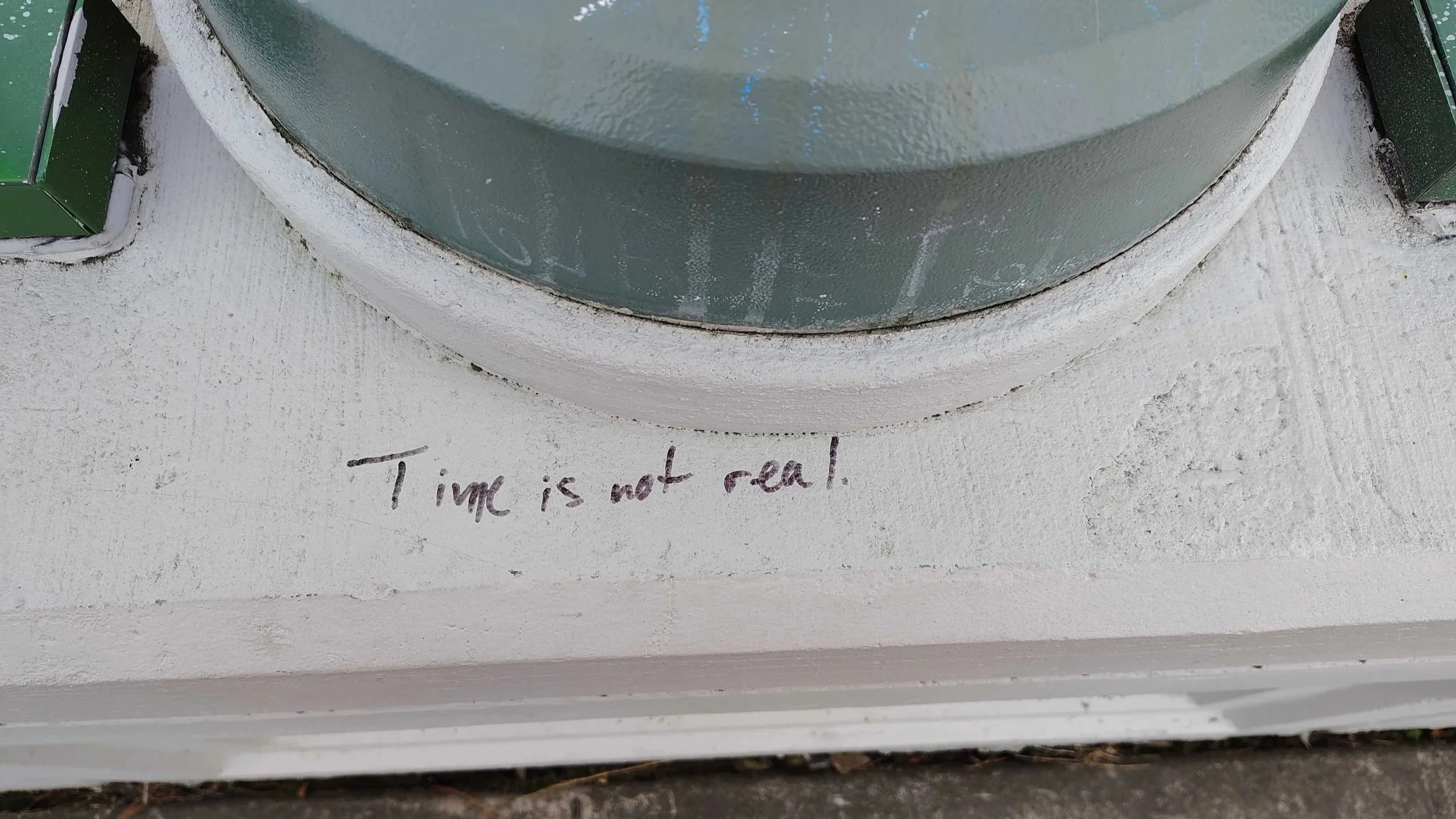
Apropos graffiti │ The Evergreen Echo
How can I question society and societal systems, without a closer look at the central point of our collective existence? We are consciousness experiencing finite time. We are born and then we die. And this inevitability is something we’re all freaking the fuck out about. So we’ve taken to hurrying, hoping we can pack every experience in, build perfect formulas to live out the perfectly scheduled and most fulfilling life. The Longevity Bros want to live forever, the Beauty Industry wants to retain the visage of youth, Hustle and Productivity Culture wants to optimize existence. And all of them want to sell you and me a new supplement, course, or surgery. They are taking a fairly standard but artificially inflated anxiety and using it to sell us snake oil.
At present we’re witnessing the Administration’s public fight to control time as President DJT personally battles senators in order to enforce getting rid of Daylight Savings Time (of course before we get our hour back). Roll Call does a fairly succinct debrief of the situation, among all the other near-constant deluge of distracting and dysregulating petty crusades taken up to keep us looking away from how they're running our pockets.
Ultimately, I’m not sure my concept of time is any clearer, and though I've embraced the schedule of a new job, the act of scheduling itself isn’t any easier. I’m still looking for my tempo giusto as Hoffman referenced.
I’m happy for now to ponder and live within that uncertainty. How are you coping with the managing your time? What does that even mean to you? Until next time!