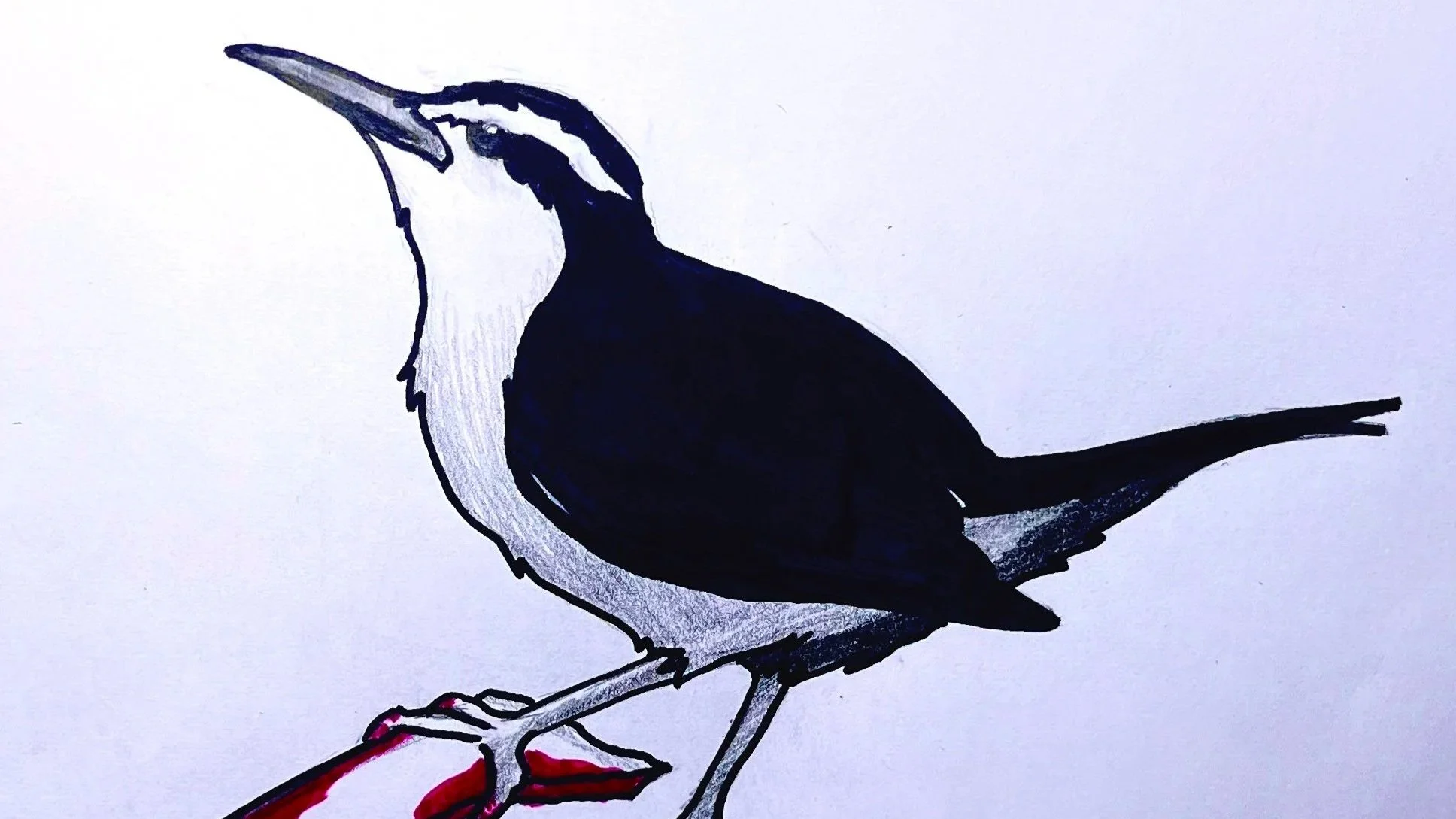
Illustration by Ethan Lee
It began slowly—the plague, the greed, the riots. Revolutionaries rose up behind symbols, murals, and songs, while the masses were fed machinery and religion. In the wake of the destruction, politicians deemed art a dangerous thing—a worthless thing—and the masses agreed. They took away the paint, the books, and the instruments. But they could not wholly silence the artists. These are the stories they left behind.
Atticus closed their hand over the jagged edge of a glass shard and squeezed until pain pricked at their palm and drew blood. Small beads of it, nothing more. Just enough to prove they were alive. Just enough to bring focus and clarity to the hurt that seemed to tear their chest wide open.
Despair settled like an infection in their bones, raging through their bloodstream and constricting their heart. It beat itself against their insides like a scream that needed to but could not get out.
Tears welled in their eyes and painted rivers over their cheeks and down their chin. Silent and insatiable.
Atticus let the shard fall from their grasp and clatter to the floor where it startled a small, wounded wren into flight. The bird looped around the tunnel in a frantic dance, sweeping toward the glass eyelets in the concrete walkway above. It had wriggled itself into the cave where one of the glass pieces had broken. Atticus had greeted it like a little god who bore great tidings of freedom. Its song had been a comfort when the rubble and rock had settled, when the dead were lain out and covered with vibrant cloth.
But it, too, was now stranded, unable to find the point from which it had come in, and it bashed itself against the remaining glass until it wore itself weary. It perched now, damaged wing dangling displaced at its side on a cleft of moss-coated stone, spotlit by the rays of colored light spilling through, freedom less than a foot away.
The shadow of a soldier’s boot blotted out one of the eyelets above the bird before opening it to the light again.
Atticus had screamed themselves hoarse the first time the silhouette had crossed overhead, the other survivors taking up whatever they could find and clanging them together in a cacophony. Then they’d heard gunfire, and they’d known with a horrible certainty that whoever it was up there had no interest in saving them.
Hunger panged through Atticus’ insides and thirst burned their throat.
A day. It had only been a day.
They touched the shattered phone in their pocket which had blinked hopelessly with lost signal till its death, a long train of messages trying and failing to get out.
Juno. Juno. Juno. Her name like a prayer. Forgive me.
A boy screamed at the pile of rock that’d closed them off from the square and condemned those still beyond it to the firing line. He tugged relentlessly at the unbudging stone, shredding his hands against its pricking edges long after the others had given up, desperate as the wren which threw itself against the glass. He’d freed the bloodied, broken fingers of someone crushed beneath the landfall but could do little else.
An ache clotted in Atticus’ heart, and their body trembled.
A harsh beam of light speared through the hole in the ground, the gilded color of the setting sun. Atticus held their hand beneath it, felt its heat pool in the center of their palm, watched the shadows of their fingers wiggle along the ground.
They’re calling it Project Eikasia, Juno had told them one morning some weeks ago. Their prison across the sound. Named after an old philosophic ideology that artists exist in a corrupted dream state. Shadow-bound, false prophets. She’d heard the news from one of the archivists. Had shared it with Atticus as a warning to take care. They want to carve us hollow, to make us docile and chattel-like.
Atticus had tried to be careful. Truly. But then the city had caught fire, and the soldiers had come to the garden and packed Atticus’ friends into the backs of black vans. Atticus had only narrowly avoided joining them.
For them, Atticus had abandoned caution; for them, they’d joined the marching masses.
And maybe—this burial—was inevitable. The punishment for an ancient crime: humanity’s eternal pursuit to defy death with memory imperishable.
Even now, a group of the survivors stood against the tunnel wall, painting their names across the concrete. One last attempt at being found, at being remembered.
Atticus shuffled toward them, knelt and picked up two tubes of paint from the collection they’d gathered. Green and red. They dipped their fingers with paint and dragged the colors against the wall. A single stem with a flower blooming at its end. Voices murmured through the room, some recognizing the mark. They stared at Atticus, waiting, and Atticus turned to face them.
Tears welled in their eyes, and they smiled. “Welcome, all, to the final gathering of the garden.” They gestured to the spot on the floor illuminated by the colored light beams. “The stage is yours. Take it. However long you need. One last time. Until death.”
The Divided Line is an original serial.