Happy Snacking: Black Forager Brings Trademark Humor + Wisdom to Town Hall
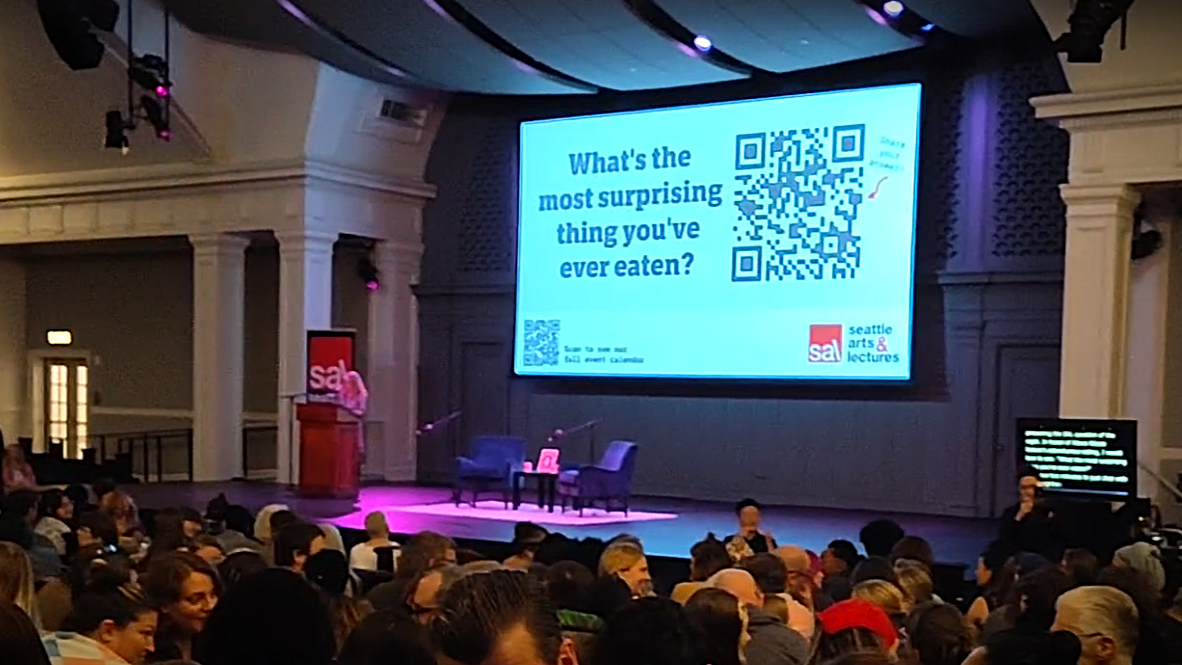
Great Hall, Town Hall Seattle, before Alexis Nikole Nelson arrives on stage.
The Evergreen Echo
If you haven’t been to Town Hall Seattle then you’re truly missing out—Seattle Arts and Lectures (SAL) has a variety of events for a plethora of interests. The evening of Monday, September 14 brought a full house of people eager to see and hear from Alexis Nikole Nelson, a.k.a. BlackForager across social media, who is currently on tour to discuss and market her new book, Happy Snacking, Don’t Die!, a recipe book of foraged ingredients with stories you won’t want to skip. The title comes from her famous catch phrase concluding most of her videos.
Before we dive into the main course, I first want to discuss the appetizers. SAL and the additional youth program Writers in the Schools (WITS) had a featured youth poet, Anjali Andresen, who kicked off the event with an evocative poem that assured me that with community support and organizations like SAL and WITS, the kids are in fact all right, and fighting for/dreaming of a better and brighter future for us.
Additionally, there were many community-building organizations and businesses providing information at booths about the specific challenges and inequities they are working to combat as we waited for the event to start. Left Bank Books was among them, selling signed copies of Happy Snacking, Don’t Die!.
Alexis came out to applause and excitement, joined by KUOW host Brandi Fullwood who came prepared for a discussion with prompting questions and to moderate the audience-led Q&A. Naturally, some of the first inquiries were if Alexis had done any foraging so far here and if she’d noticed anything different about Seattle compared to other places, to which she described Seattle as being very green, with lots of tree coverage, something cities in her home state of Ohio lacked and was learning the hard way during the currently ongoing heatwave. She’d already done some foraging, utilizing a leaf from a broadleaf plantain plant right in front of her hotel to soothe a mosquito bite.
Fullwood welcomed back the student poet Anjali to ask her own question: “What is one memory that you bring with you wherever you travel?” Nelson recalled gathering beach plums with her mom at the very beach where they’d scattered her grandmother’s ashes.
This led into questions of how Alexis had gotten into foraging, which she reminisced as being either from “loving exasperation or inspiration” on her mother’s part while attempting to garden in the presence of a “helpful” 5-year-old. She recounted being directed towards a patch of grass, different from the rest, that smelled of garlic when grabbed. From there she attributed the comparative benefit of learning languages as a child to the robust memorization of not just the names of the yard plants, but also their relation to one another. A lesson hammered home by her mother’s quizzing.
“If you are waiting until you feel ready, until you have all the tools, all the knowledge, you’ll just be waiting. …[Foraging is all about] making do with the tools you have, you [often] don’t have to go much farther than your front door.” —Nelson, advising prospective foragers.
If you’ve seen any videos from BlackForager, it will come as no surprise when I say Nelson is one of the funniest speakers I’ve encountered. The audience was in stitches as the humorous and conversational flow of the Q&A was occasionally derailed by funny tidbits and tangentially relevant stories.
When asked about the difference between making educational content online and writing a book, Nelson explained the creative challenges of transmuting and finding a bridge to best capture her voice and manner of storytelling by recording herself telling the story of each recipe and plant. For her, including the recorder allowed her to connect with the cultural importance of oral history as well. She gave a hilarious shoutout to Simon & Schuster for their interest in what she called a “peculiar girl’s peculiar book.”
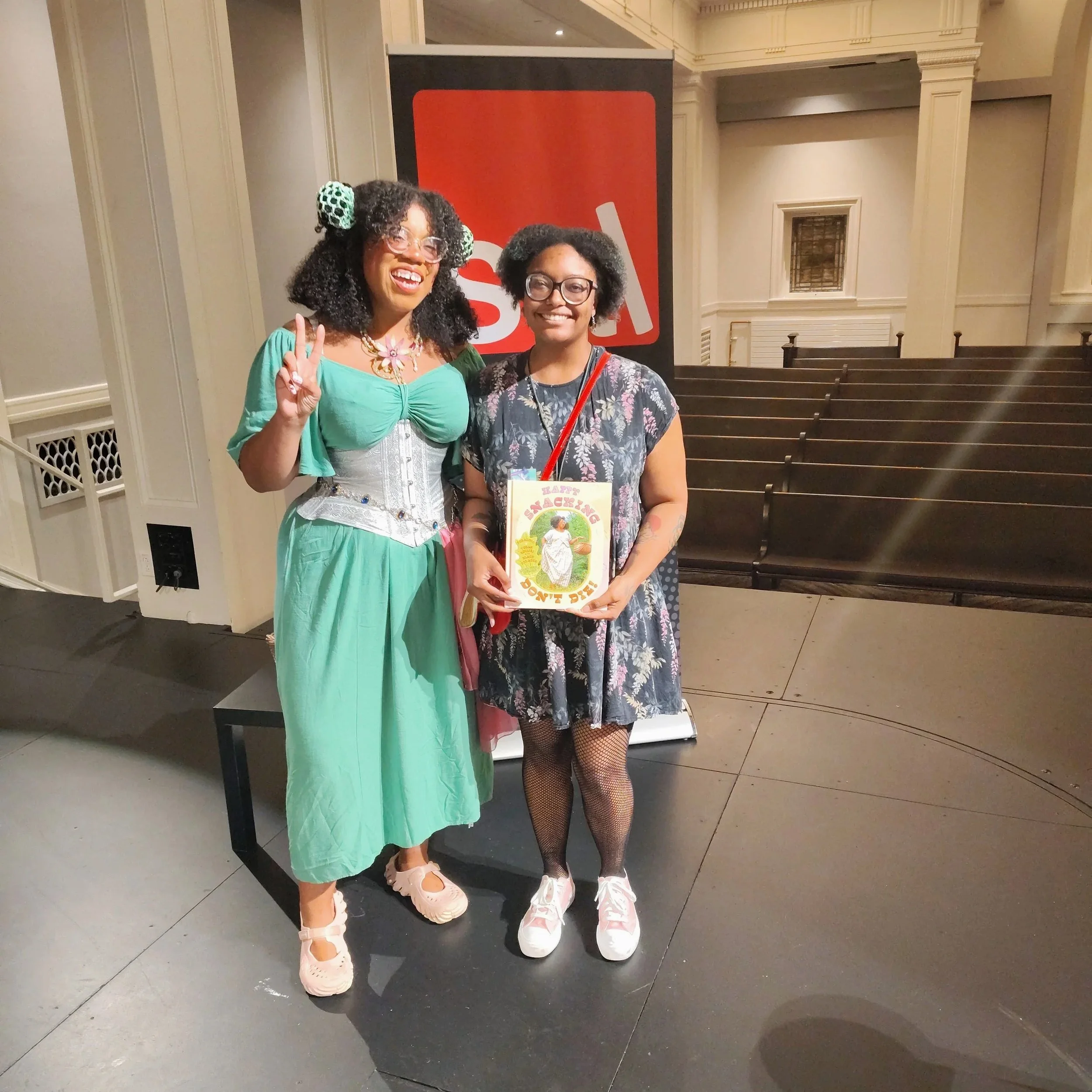
Alexis Nikole Nelson and Raegan Ballard-Gennrich
The Evergreen Echo
Some topical questions arose from both Fullwood and the audience, tackling everything from how the availability of foraged ingredients determined what meals she cooked, and how much of her meals were completely foraged, with the fall season being one of the best times of the year to create fully foraged meals. One of the more serious topics was why she initially proclaimed herself as a “filthy vegan,” which began as a term of “gentle self-deprecation” intended to distance herself from the offputting, preachy, and mean-spirited vegans on social media, and evolved into a reclaimed personal choice for environmental and social harm-reduction.
She also detailed further thoughts on foraging as a way for someone of Black and Indigenous descent to soothe the ancestral disconnect which she described as being like an “aching, gnawing feeling” inside of you. Foraging allows her to pay homage to her unknown ancestors by having some of the same knowledge of and connection to the land that they would have needed to survive. It is something that brings her closer to the people she’s made up of and encourages novice foragers to think of the experience as an opportunity to “go back in history to find the forager” (Nelson). She took a brief detour to rail against criminal non-trespass laws (legal barriers to foraging) existing to prevent recently freed enslaved people from feeding themselves and their families with the intention to keep them dependent on and indentured to plantations.
I greatly appreciated her stance that plants and animals are our “non-human neighbors” and that foraging is a reciprocal relationship between us and the land that shelters us. This was even evident in the proposed solution of “eating into submission” ‘invasive’ plants such as the Himalayan blackberry, prevalent everywhere in Western Washington.
When asked about the recipes in the book and her process for creating them, she explained that her philosophy equated scientific experimentation and play. Without any spoilers, the chapter for magnolias provided the greatest opportunity for trying and documenting different techniques to capture the smell of the fragrant buds and flowers in as many ways as possible. She’s currently tackling zanthoxylum for play/experimentation. She did manage expectations for another book as a daunting 10-year project so I’m sure we can occupy ourselves with her first one in the meantime.
I am incredibly thankful to SAL for hosting Alexis Nikole Nelson and bringing some of the most fashionable plant lovers to Seattle while she continues on her book tour, representing us weird Black girls. Happy Snacking, Don’t Die! is available nationwide.
Headphones recommended