Parker’s Pages: A Psalm for the Wild Built
The Evergreen Echo
In preparation for Becky Chambers’ upcoming Town Hall with Caitlin Starling, I took some time to reread A Psalm for the Wild Built, a solarpunk novella following a tea monk named Dex and a curious robot named Mosscap. The book is wonderfully optimistic and introspective, having us question what is most important to us as people and as a society. Chambers’ beautiful prose strings us along and this novella holds a very special place in my heart, especially as we move into these cozier fall months and our beautiful PNW is finally giving in to rainfall.
What struck me most this time around is how relevant the story has become in light of recent political and technological events. As we come to terms with the very real ways that AI (or SI as our President has proclaimed it to be) and robotics are impacting our social, economic, and existential structures—as well as how the tech could potentially or theoretically impact us—books like this that explore alternate routes and possibilities have become, at least for me, something like guides or blueprints.
Chambers dedicates this book to “anyone who could use a break” and that’s definitely how this story arrives; it’s a peaceful look into an alternate world not quite so different from our own, leaving room for escapism and a glimpse into reality at the same time. Most interesting to me, in light of the claims made by AI giants like Anthropic or OpenAI that we are “in the singularity,” is the opening prologue of A Psalm for the Wild Built. In it, a historian named Brother Gil narrates a brief history of the book’s world, placing us into the setting for the rest of the narrative. He shares the message sent to the people of this world from robots, machines they built to help in factories and for manual labor:
“All we have ever known is a life of human design, from our bodies to our work to the buildings we are housed in. We thank you for not keeping us here against our will and we mean no disrespect to your offer, but it is our wish to leave your cities entirely, so we may observe that which has no design—the untouched wilderness.” (p. 2)
Whether or not you place much stock in the words of ex-Anthropic researcher Jacob Coxon and others who claim that AI is on the path towards intelligence, consciousness, and the possible end of humanity, Chambers’ work does pose an interesting thought exercise. What if the intelligence and robotics we design do become conscious? What if they decide they do not want to work for us, and what if they, like many of us, care deeply for nature and wish to study it? While a future like that is perhaps too optimistic for some, it is wonderful to live in, even for a short time within Chambers’ pages.
The Evergreen Echo
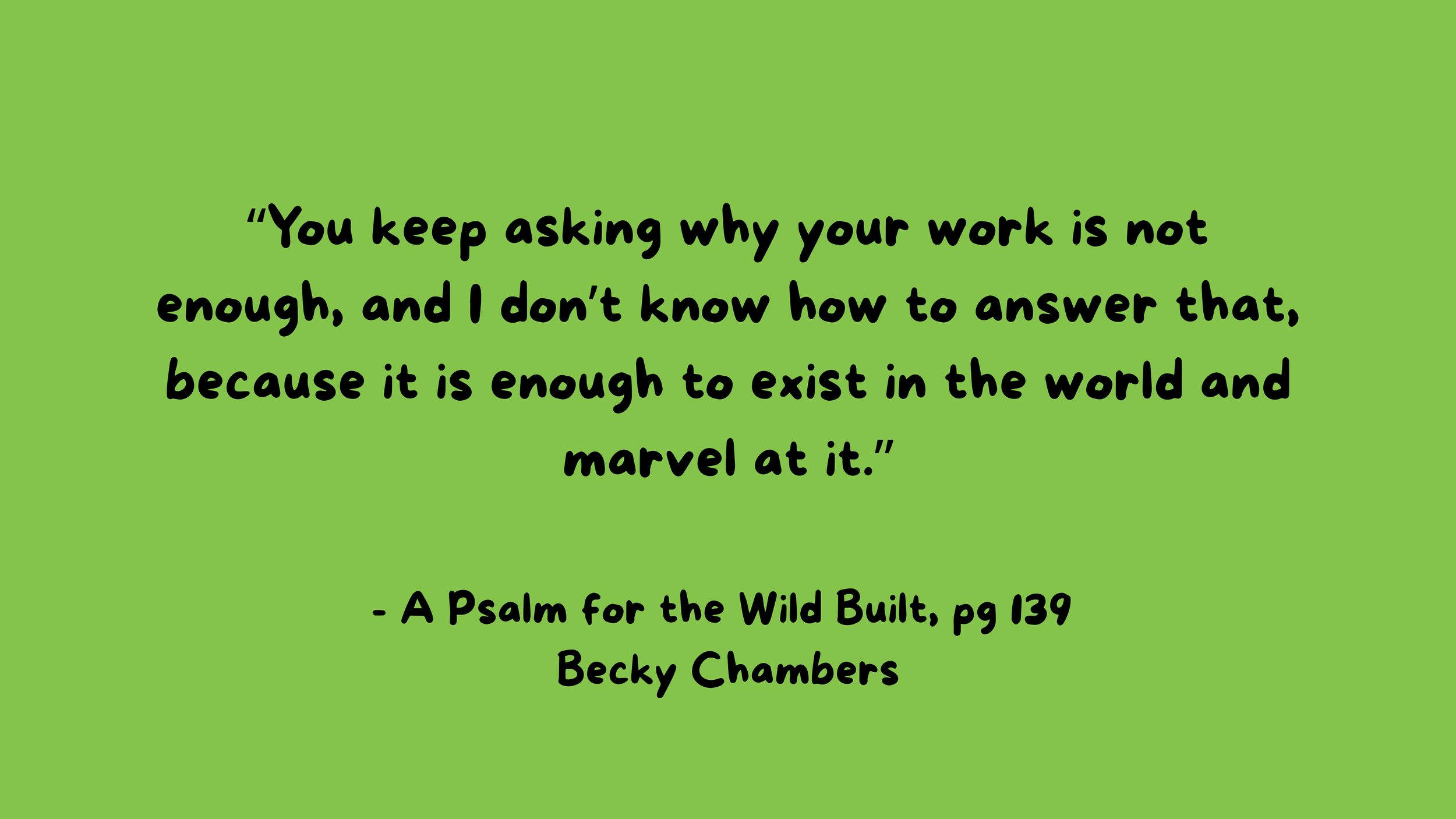
The world Chambers creates is quite simply beautiful. The imagined world is one where humanity decides to peel back layers of infrastructure and urbanization, creating small cities that live harmoniously with nature. The society is care-full, as in full of people who care for one another, and someone’s job can merely be to offer an ear to listen and tea to drink. And in that world, which we might call a utopia, Chambers still is able to pluck out more layers. She begs the question: In a perfect world, would we still long for more? In the case of her main character Dex and their lovable robot companion Mosscap, the answer is yes. There is still something to long for—purpose, meaning, an undefinable need.
If you are someone who, like Chambers says, needs a break, this is most definitely the book for you. A relaxing look into a solarpunk and vibrant future awaits. And I recommend you stay tuned for my review of Becky Chambers’ Town Hall event with Caitlin Starling, where Chambers will be discussing her newest book As You Wake, Break the Shell, a dystopian novel exploring some of our current existential and philosophical debates, namely about climate change, survival, and connection.