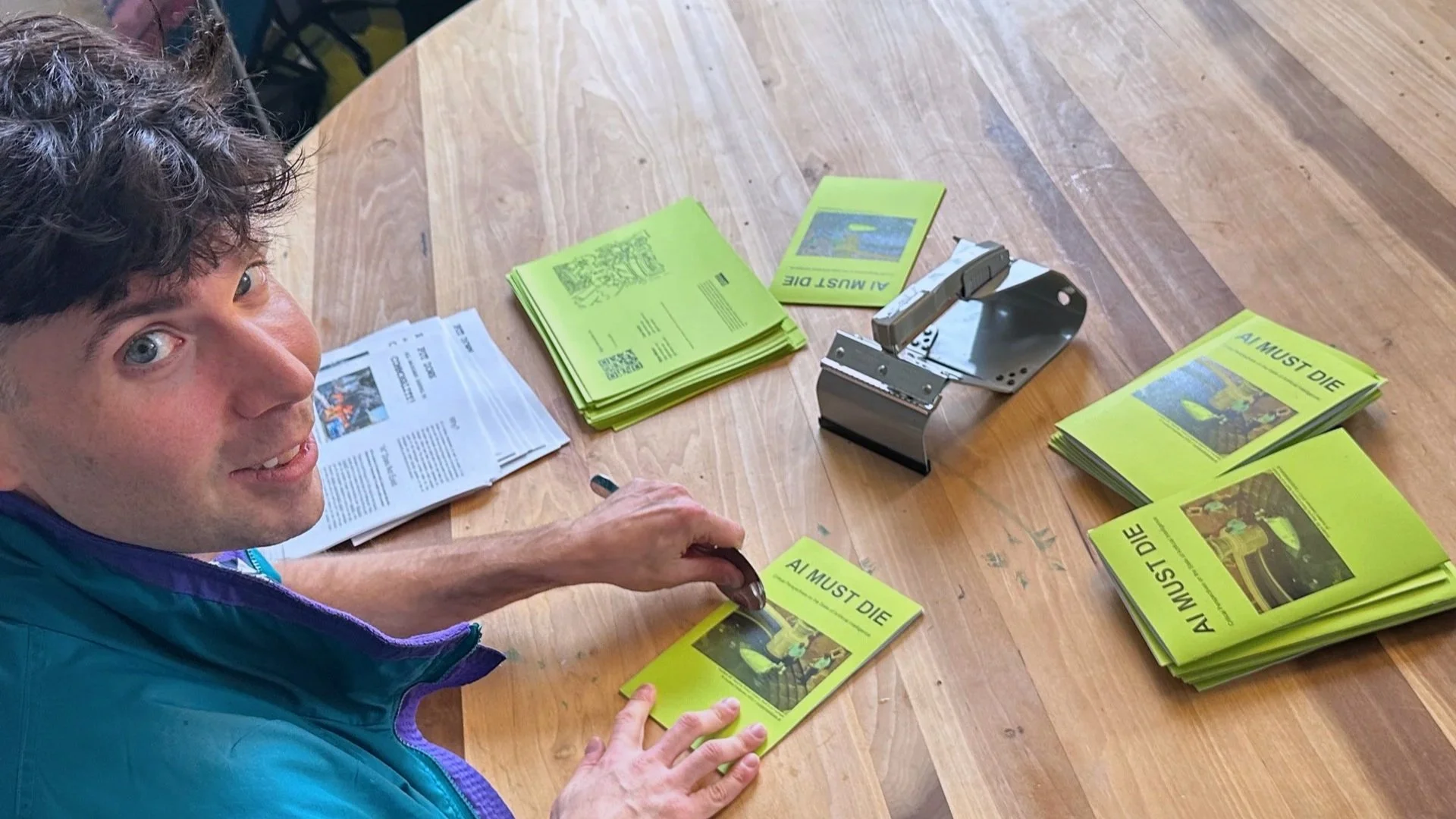
Cam Smith assembling his popular zine, “AI Must Die” │ The Evergreen Echo
Cam Smith’s residency and final show at Passable ended early this past Friday, November 20, after making it known to other artists that their upcoming show would support the art scene's arguably most problematic donor: Andrew Conru.
There was a lot of he said/she said in the exchange between Cam Smith and Shelly Farnham, Passable’s president. Cam believes the show ending early was done out of retaliation for his mass email to the Passable artist community sharing information about Conru’s donation to Human Diversity Foundation, given how the words and actions piled up alongside Shelly’s apparent loyalty to Conru and his friend Marty Griswold of PublicDisplay.ART. The upcoming show, Let There Be Light, is to be hosted at Conru’s Coliseum of Art beginning on November 27. Shelly asserts that ending Cam’s show (and residency) was either a scheduling snafu or else a prior arrangement known to Cam, but the timeline revealed by their email exchange appears somewhat suspicious.
To spare the reader a lengthy email thread, the events unfolded thus:
Nov. 13: Cam emails Shelly invoices for his work. No other emails in this thread until Nov. 19.
Nov. 19: Cam emails Passable’s artist members regarding participation in the Let There Be Light show, informing them of Andrew Conru’s dubious donations and why he personally would not endorse a show in Conru’s space. That same day, several artists congregated at a pizza party and are rumored to have discussed Cam’s letter.
Nov. 20: Shelly informs Cam of a birthday party on November 21 and “will need at least one side of the room clean.”
Nov. 20: Cam replies, “I have gallery hours 2-6 tomorrow, so I'll need the whole space intact until then. I hope this isn't retaliation because of our difference of opinion about Conru! I think we can work together despite disagreeing.”
Nov. 20: Shelly responds, “No April had it scheduled far in advance and you had said you'd take the show down after the pizza party. You'll have to cancel tomorrow. Regarding the Conru thing—I truly think you owe Marty an apology for trying to sabotage his show. Sending those emails was not ok.”
Nov. 20, Cam: “You reposted my gallery hours publicly on Instagram and were informed in advance.” The Stranger had reported the hours ahead of Cam’s show; Cam is referring to Instagram’s stories, which by the time of this publication have vanished.
Nov. 20: Shelly asserts Cam must apologize to Marty, and that Cam had said he’d take down his show “immediately after yesterday’s event.” “I've been quite happy with your residency until yesterday.”
Nov. 20-21: Email thread with Shelly and Passable members. Cam takes down his show and was told to be there when the space was empty. Shelly again insists Cam apologize to Marty.
Mary (M): Were you made aware of the birthday party prior to setting up your show or had Shelly ever mentioned it to you?
Cam Smith (CS): “No. I told Shelly about the gallery hours I was planning to do, and it was posted on Instagram, and there had been other small events during the course of the show. The space is not huge, but there is a front gallery space and a large back area where a lot of tables are, so definitely possible to accommodate multiple events at the same time… The fact that Shelly started off saying she needs half the space cleaned then escalated to saying she in fact needs the entire space and needs to cancel the gallery hours… says to me that she retaliated. …The last gallery hours were Saturday, 2-6. It was only three showings, so a third of the show was cancelled.”
While it appears that the birthday party for April was scheduled via a Partiful invite that Cam might not have been privy to, the reminder in Passable’s Slack chat from April (provided by Shelly) was dated November 17, 2026, the Tuesday before Cam’s show was to end and six days after the show’s opening. It’s certainly forgivable to forget a scheduling mishap, but Shelly presented the party information to Cam only after he sent the mass email.
In comment to this story, Shelly insisted that Cam apologize to Marty Griswold for attempting to sabotage the Let There Be Light show. When asked what purpose this would serve, she responded, “I truly believe what he [Cam] did was wrong, he tried to harm Marty's show without giving the artists who are participating the full picture… by in no way acknowledging Conru’s disavowal of racist ideologies and withdrawal of support from HDF the moment the Guardian approached him about it, or Marty's work the past couple of years supporting the arts via PublicDisplay.ART and the Conru Art Foundation. He put the artists in a very awkward position, and caused harm to the wellbeing of that community and the art show. I want to see Marty & Conru continue to support the arts and the artists continue to receive that support without feeling bad about it. Artists in this domain rarely receive money for their work. Think of it this way: do you ask everyone who works at Amazon to quit their job because Jeff Bezos donated to Trump?”
Is an Amazon worker of the same ilk to critique their paycheck’s signer as an artist usually untethered to one specific company? Perhaps the feeling of entrapment varies from individual to individual.
Shelly has every reason to defend Conru. Her other venture, Third Place Technologies, also received a donation from the Conru Foundation in 2024 for $20,000 and another $10,000 in 2025. It openly acts as a non-profit buddy to Passable. According to her, “He [Marty Griswold] speaks to Andrew Conru on a daily basis and I've known and worked with Marty for 15 years.”
Cam was open about this situation, as he is any time he sees an opportunity to critique Andrew Conru.
M: Were you, as Shelly says, trying to sabotage the show? What were your intentions for sending the original email?
CS: My intention for the original email was to raise awareness about Conru, to share the reporting that’s been done with people who might not know and give artists an opportunity to feel like they’re not reliant on Andrew Conru for recognition. [I did] offer an alternative, so I was agitating for change, certainly wasn’t sabotaging the event or threatening people or threatening reputational damage. …My belief—my opinion—is that many of the artists with work in that show are relatively new or inexperienced or that they’ve only been contacted by this narrow tech arts scene, and I wanted to remind them that there’s lots of other arts groups where they can show their work. So certainly not saying that someone is bad for working with Conru, but simply providing information so people can make their own choices.
M: Was the timing intentional for you to send the mass email on the day of the pizza party?
CS: Not really, but it definitely made a splash. The reason why I waited till the last moment to send the email was because I was anxious about sending it. I have no problem talking one on one with people, but I felt I had to do something, so I waited sort of until the last moment that I could do it, at the end of my residency. Not intentionally planned, but it ended up having a splash, which I don’t regard as a bad thing.
M: Before you began your residency, or in the process of setting it up, were you aware of Conru’s involvement with Third Place Technologies?
CS: I knew that he supported them [Passable] by giving money to fund a Burning Man-adjacent event they do in the mountains involving art and technology, and I knew he gave money to that, which I did not attend as a result…I was invited to attend, but I didn’t want to go to an event funded by Conru. …I’m not really happy myself with Conru giving any money to arts organizations cuz there’s always strings attached, and I’m not an expert in the art world and art funding, but my impression is that if you are potentially a problematic donor like Conru, and you’re donating money with a few strings attached for existing programming, that is less problematic and less objectionable than artists coming to your space with your name on it to try to directly meet you. That sounds more like an endorsement.
So I was not happy with Passable’s involvement with Third Place in the past, but I thought being in the space, sharing my opinion could, and did, change the minds of some people …What crossed the line was when I saw everybody producing artwork for Conru’s show where…if you’re an artist in that show, you’re going to meet Conru, shake his hand, his name is going to be on the venue…in my mind that’s a bit different from just giving money to support an organization.
-
“The Third Place nonprofit has gotten about $7 to $10k from Conru the past few years which is about 7% of our operating costs across all the nonprofit's activities.” -Shelly’s email to the Passable community.
-
Shelly emailed to say:
“Passable is run as a partnership between Totally Legit LLC and the nonprofit Third Place Technologies. The art exhibitions are run entirely by Third Place Technologies including Cams show. Passable is not a legal entity it is just the name of the space. “
-
“Please add that Cam attended the PNW Arts and tech symposium (which Third Place hosts) two years in a row, the first year we had the Conrus logo on our flyer. We know Cam knew because he put an anti-Conru graffiti on the bathroom at the event. He gave talks at both events. Yes, we invited him back and he came back the next year even when he graffiti'd the bathroom.” -Shelly, in an email to the Editor, Nov. 25.
Full disclosure: Like most interviews in any publication, Cam’s was edited for brevity and, in this case, to flesh out other aspects of the article. Here is his quote originally not included:
“Yeah so I had learned last year there was the Art + Tech Symposium, and I saw Conru’s name as a donor to the thing, and I was of course very shocked, I had already learned of Conru at the time, this was after I had already pulled out of the Seattle Art Fair…and I was shocked to see Conru’s name on the Art and Tech Symposium; during that time I was already there and giving talks and I felt like I could make a positive impact by remaining there, it wouldn’t make much sense to totally withdraw. So I started putting up posters about Andrew Conru around the venue site for people to look at, just a QR code to the Guardian article, again not really my opinion, just a link to the reporting on the situation. And it was nice, cuz I actually built quite a good network of people who saw these posters, could guess it was me, and found me and chatted about it. So it was a good experience and I felt like being in this space I was able to spread word about Conru in an effective way. This year, the Art + Tech Symposium which was also hosted by Third Place Technologies was not funded by Conru. I dunno why that decision was made not to have Conru this year, but I hoped or thought maybe it was because of my raising awareness, cuz a lot of the artists I talked to from the Symposium were not happy that Conru had supported after they learned about him."
The rest of his answer begins with “I knew that he supported them…”
It’s also different from supporting an organization that’s going to go under from lack of funding. In the [Passable community’s] email thread, one of the members says that Conru only provided about 7% of the funding for Passable*, so it’s not as though they’re really dependent or reliant on his funding. So the thing I thought was troubling was that Passable was making more of an ideological statement than one of necessity. There are other arts organizations who’ve taken Conru’s money reluctantly (this is hearsay from folks I’ve talked to), they understand he’s problematic; they don’t like it but they feel desperate. Unfortunately the response I got from Shelly was not one of desperation, it was one of ideological alignment. She believes Conru has changed and has no problem taking his money.
I think if you are gonna take money from Conru, it’s more justifiable if you’re desperate and you understand the dilemma you’re in. Passable is neither desperate nor feeling conflicted about this, which is a problem because the whole broader issue is that a wealthy technology entrepreneur who’s done horribly racist things can rehabilitate his image by giving out money. What I’m concerned about is currently there’s no arts organizations that publicly support Conru and is Passable going to be the first that crosses that line? Tolerance or reluctant acceptance to direct public endorsement of him. I was hoping during my residency that Passable would move away from Conru, but it seems like unfortunately they’re doubling down.
Cam clarified: “I don’t think someone’s wrong for taking Conru’s money—I’m saying we need to discuss this.”
Shelly’s tack seems to be that Cam should be grateful for the residency, show remorse for his actions, and the arts community should maintain loyalty to Griswold and Conru for supporting their work.
In her words: “I do not believe this incident speaks well about [Cam’s] character as a person at all, considering we gave him a free membership for a year, supported him entirely in his November show, including a $1000 stipend, the space he occupied for the show had a fire in March and we got $7500 from the Conru Art Foundation grant to help recover repair costs, and he knew perfectly well the Conru Art Foundation had supported our partner nonprofit Third Place Technologies in the past, who hosts the art exhibitions at Passable (I am the President), and as of a week ago while sitting across from me at the table from each other, he told me Passable was a "gem". He also knew perfectly well we are planning on hosting a fundraising party in the Coliseum of Art in December and several Passable artists would be exhibiting there in the Let there be Light art show.
This is the move of a bully, trying to make clickbait.
…I have known Marty for years, we've actively partnered on projects since 2023, he's a great supporter of the arts in Seattle, and only deserves our respect.”
She further stated: “There is no reason—and no behavioral evidence in the past several years—to not take him [Conru] at his word that he is pro-diversity.
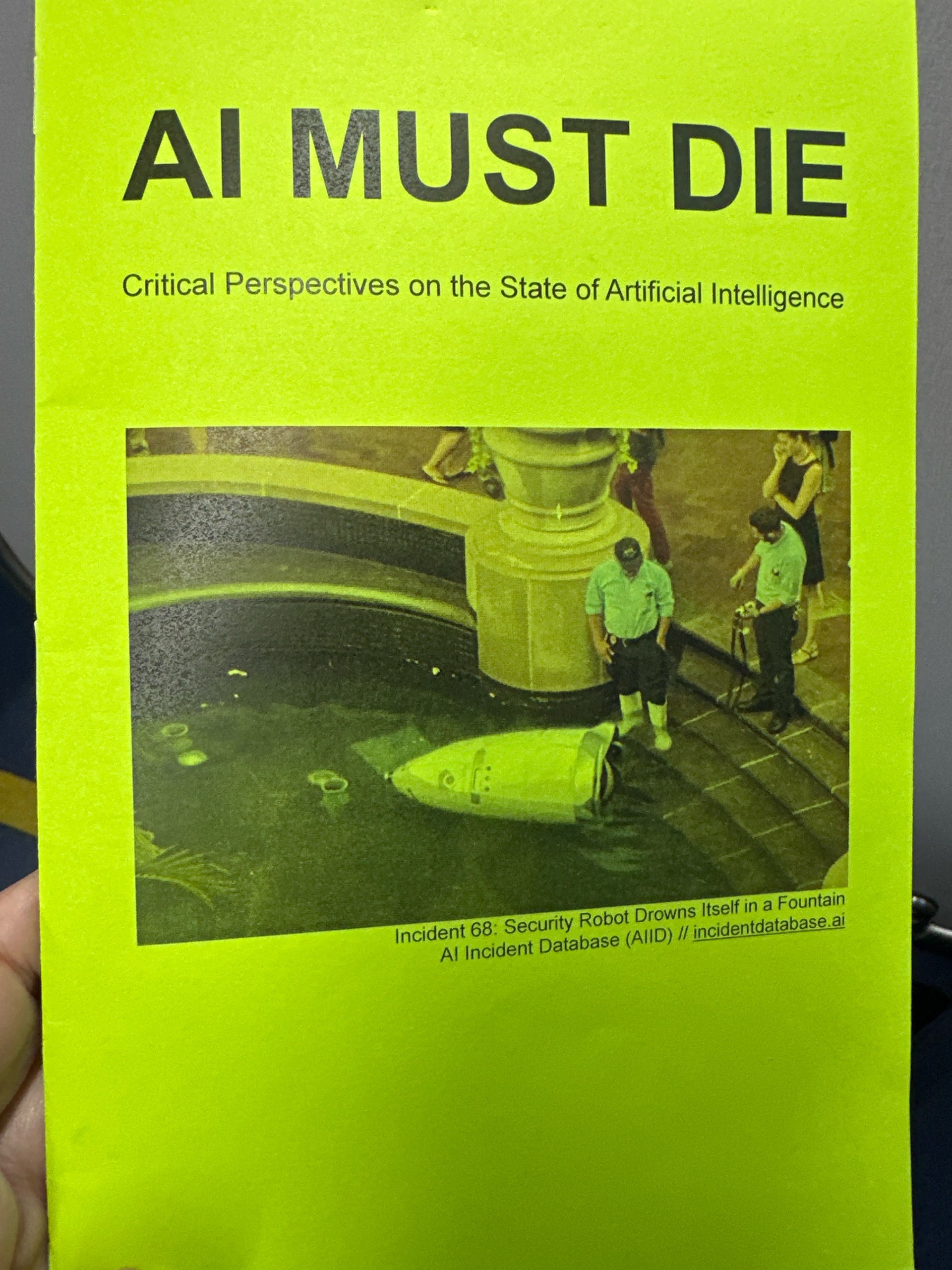
Cam’s zine, a collaboration with Myke Walton
The Evergreen Echo
I truly respect Marty / PublicDipslay.ART and would never cut a connection just for fear of their reputation in the minds of people who haven't taken the time to know them. The obvious thing to do is what is right, and in my case that is supporting a good organization doing good work, I have no problems endorsing the Conru Arts Foundation and PublicDisplay.ART, given their very meaningful and positive impact here in Seattle.”
It’s entirely possible that Shelly is ignorant of Conru’s history of donations besides what Cam listed—HDF and FIRE. It takes a bit of digging and correlating to find exactly what the Conru Foundation has been up to outside of the arts arena. And the piled-up evidence is startling at best, damning at worst. Some might narrowly view the arts funding alone, while others may do some serious evaluation regarding perceptions of Conru’s character.
Shelly also stated: “The reality is Seattle is very community-oriented, which I love—and if you pull on a social string a whole web of relationships come up. These are real people, not political abstractions. With that in mind, as Rachel Maddow says, watch what they do, not what they say. See people for who they are and how they are interconnected, not by how they match to some stereotype. Judge them by their actual behavior and their network of friends who trust them, not by an article from several years ago.”
Agreed, actions should be considered. But it is just as easy for each hand to operate independently as it is for one to speak directly opposite their behavior. Conru’s history of donations is public information and does not bode well for his supposed apologies or assertions of reformation. The Guardian piece was published just two years ago, alongside a slew of others that popped up the same month revealing the HDF $1.3 million Conru gave.
As for the “no behavioral evidence,” let’s take a look at Conru’s donations since 2019, available on ProPublica:
Beyond the $1.3 million to HDF (now branded as Polygenic Scores LLC) he upped his donations from $25k in 2019 to $100k in 2020, then back to $25k in 2021 to Turning Point USA, Charlie Kirk’s infamous white supremacist student network. To recap, the Human Diversity Foundation was a eugenics think tank dealing in “race science” narratives.
American Conservation Coalition: $10k in 2019, $25k in 2023, $50k in 2024, and $25k in 2025. The name alone to an untrained Seattleite’s eye may read ‘yay, conservation!’ but DeSmog dispels that notion.
Reason Foundation: $25k in 2021, an organization self-described as Libertarian. Perhaps not as damning as the others, but Libertarianism is widely seen as white supremacist-adjacent or white nationalist-Lite by leftists and progressives, as it is usually proven to be yet another branch of conservatism wearing the cloak of so-called "rationale" and “free thought.”
National Progress Alliance, led by known “anti-woke” conservatives like Dr. Peter Boghossian, received a donation from the Conru Foundation of $300k in 2022. And the same amount again in 2023, just three years ago and one year before the famed HDF donation. $300k seems to be on the higher end of the Foundation’s spectrum of giving, compared to the varied donation amounts between 2019 and 2025.
The Unz Review, 2020: $5,000. The Review is reportedly “a white nationalist blog, published and edited by Holocaust denier Ronald Unz.”
The anti-Trans Foundation for Individual Rights and Expression: $20k in 2019, $200k in 2020, and $200k in 2021. Conru has since attempted to denounce “autogynephilia.”
He donated $25k to the Center for Immigration Studies in 2020 and 2021, an organization designated as a hate group by Southern Poverty Law Center assumedly in 2020 after the election of President Joe Biden. It’s entirely possible Conru knew of this designation.
We Heart Seattle, as reported by Divest SPD and corroborated by ProPublica: $100k in 2023, $350k in 2024, and $150k in 2025. That’s not “several years ago”—that’s within the past three, and a whopping $600k total. The organization has been widely criticized in the past few years both on and off media outlets for the hypocritical nature of its approaches to homelessness and drug use, namely due to its advocating the criminalization of people adversely and disproportionately affected by systemic oppression and lack of healthcare. WHS has been deemed racist partially due to Seattle’s disproportionately high percentage of BIPOC unhoused people they claim to help (and then don’t).
These are only the publicly listed donations; many sources have claimed that Conru has also privately donated to right-wing individuals, associated or not with the above groups.
If Conru’s apology for his HDF donation were genuine, how does he explain this history of donating to other anti-Trans, white supremacist, or right-wing organizations since 2019? Is Conru just another ignorant rich guy jizzing his money all over town without considering the harmful impacts?
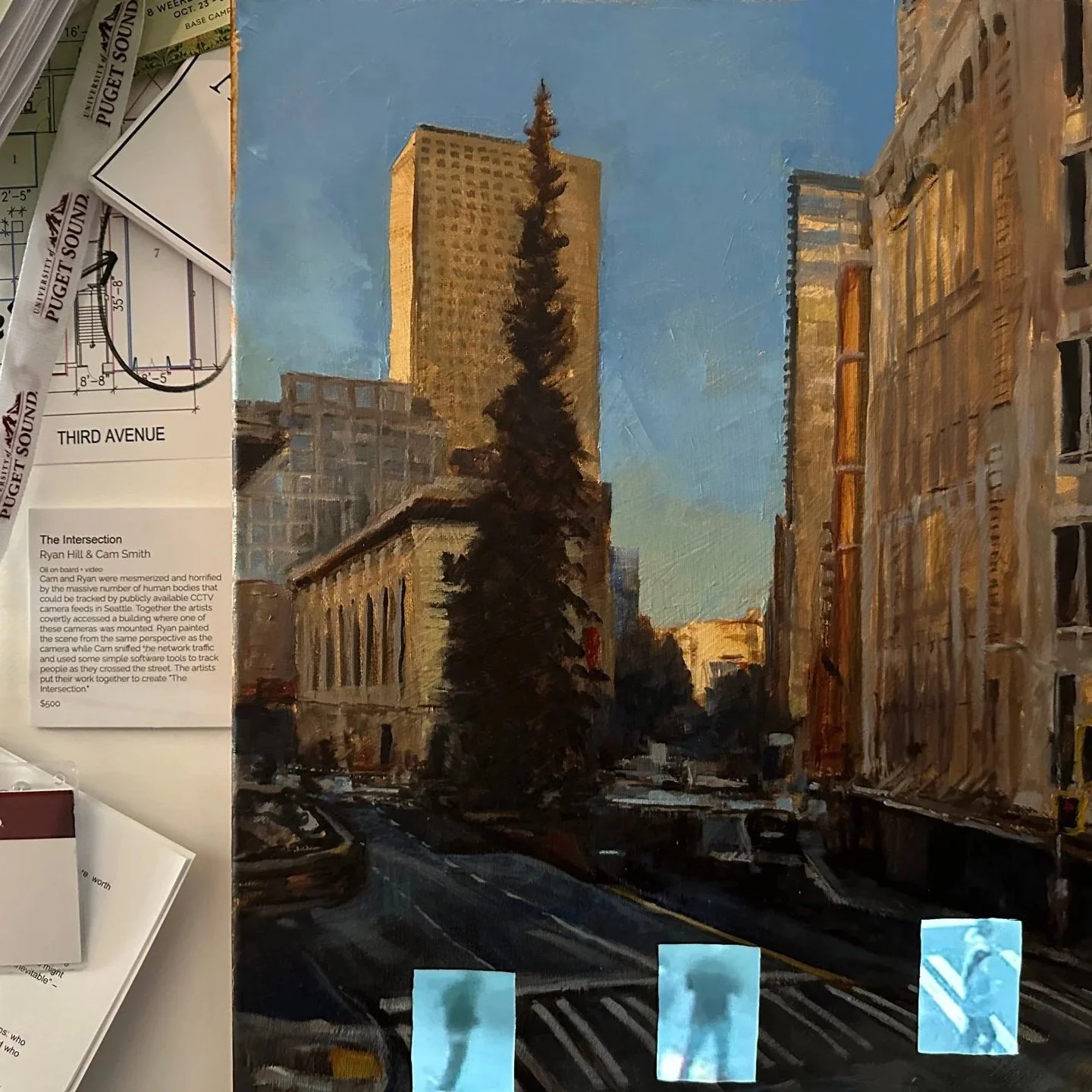
“The Intersection” by Ryan Hill and Cam Smith, formerly in Cam’s Passable show
The Evergreen Echo
It should be noted that after 2022 Conru seemed to focus more on proliferating his arts donations, spreading them out in increments between $1,000 and $40,000 across various organizations. So if anyone believes, as Shelly says, “the whole notion that a millionaire long past retirement age would spend so much money…supporting the arts in Seattle because he was trying to convince people he's not a white supremacist,” the donation chronology may be of interest. Prior to that year his funding seemed all over place: The Trevor Project here, a science group there, a Lutheran church, etc. amidst the aforementioned egregiously conservative and openly racist groups. Bluntly, Conru donated to American Conservation Coalition and We Heart Seattle after making his 2024 apology with a promise to look into charities more closely.
M: You mentioned the line being drawn between an act of financial desperation where you feel like you can’t refuse someone’s funding of your work and an endorsement where you’re actively participating in someone’s event. In light of this and if more comes to light about Conru, do you believe more artists should be cautious about where and how they display their art, and what can they do to balance their need for a paycheck and show their work in alignment with their values?
CS: One important thing to bring up is the fact that there is a line. [Regardless of] my opinion on where that line is, I think it is important to discuss ‘is there a line?’. Because some artists I’ve talked to have essentially said there is no line, there’s ‘no ethical consumption under capitalism.’ That’s the argument they make, therefore they’ll take money from anybody supporting the arts, it doesn’t matter what [their] beliefs are or what they’ve done, because all the money is dirty. And I think this is kind of a nihilistic take; I think [it should be] ‘not all bad behavior is equally bad’ and I think that position is not an easy one, because it then requires effort for you to look at and examine, critically think about these things. It’s much easier to say ‘it’s all fucked, I don’t care.’
Regarding…working with Conru, my personal experience was: I was commissioned to make art for the inaugural opening of ArtLove Salon, and simultaneously a copy of the piece at Seattle Art Fair. The day before the opening of those events, one of the artists adjacent to the team I was working with was like “I gotta show you this Guardian article.” This was probably seven months after [it] was released. I read the article and was horrified. So I immediately asked to take my name off of [the shows]. Then I was like ‘this is not enough’ …I had a crisis, I was new, it was a good paycheck… so [was] I tanking my art career, burning bridges? I was stressed and anxious, then I reflected and was like, ‘No. The Holocaust. This is where this kind of shit leads.’ So I ripped up the check, and because the art was a technology-based piece, I was able to [remotely disable it from my computer]. …And I remember how stressed and disgusted and horrified I was, especially for myself, having worked for this and not reflected enough.
I think artists should be aware of Conru and should be looking more at where the money comes from. And I’ve made mistakes plenty of times, not looking into the organizations or the funders… I think artists should do more research, but also should be more open to criticism. So my problem with Passable was not that they disagreed with me, cuz I know plenty of artists who disagree with me, they think it’s fine to work with Andrew Conru, but they don’t censor people, shut them down, and bully them. That’s sort of where power gets involved. And that’s the problem, using power to shut down a conversation.
Cam iterated that by association, Passable’s president had the power behind her to shut down the show and effectively cut off his opportunity to sell art and make more connections. “Andrew Conru does horrible stuff, he then donates to organizations like Passable, one of the artists there criticizes Passable, then gets cancelled. I was cancelled by Andrew Conru—by his influence. Even though Conru didn’t tell Shelly to cancel me…I don’t think Shelly’s racist or a eugenics supporter, I think Shelly wanted a spot to do art and just didn’t care about the crime of eugenics or the horrors of the Holocaust. …Unfortunately in her mind, that was smaller than the apology he gave and the money he’s providing.”
To be clear, he enjoyed his residency as a whole and had a good working relationship with Shelly until November 20. Again, there’s the timing of closing the show early, getting notified about the birthday party in the space only after his email went to Passable artists, the escalation from clearing out half the space to cancelling his entire show, in addition to the birthday party not beginning till 7:30 p.m. while Cam’s gallery hours were advertised as closing at 6 p.m. …The pieces don’t add up to simple poor planning or forgetfulness. Furthermore, the space has reportedly held gallery hours and side events simultaneously in the past. Cam’s suspicions could be valid even if he doesn’t want to vilify Shelly.
Regardless who is to be believed, there's every reason to be critical of Conru’s involvement in the Seattle arts scene. Conru seemed ignorant at best when interviewed by Erin in the Morning; in that interview, he mentioned that it was difficult to find Trans research, to which the article replied that in this current era the materials are plentiful from actual Trans writers and researchers. (Conru got his start in computers and the web, right?)
M: Is it possible that Conru is just a [insert choice word here]? Is it possible that he wants to fund the arts and he doesn’t vet his donations properly?
CS: It is possible…that Conru has changed his mind, that he once believed in eugenics and race science, and he’s reformed. There are people who do do that. They have a story about their feelings and thoughts, denouncing their past, they make amends, and they reflect. But I don’t think Conru’s done that. He described this donation [to HDF] as a whoopsie-doopsie, like an accident. A lot of hand-waving. And I don’t think you can donate that much money [$1.3 million] on accident. Theoretically, he's vetting the groups he donates significantly less money to, why wouldn’t he [have vetted] the eugenics group?
In my life, working with many organizations, it’s not hard to figure this kind of thing out. I think the leader of the eugenics group [HDF] was openly white supremacist [Erik Ahrens], so it’s not like it’s a secret thing. …I think it should be pretty easy to find out. He’s a tech guy, he has a computer, he can run a search. So I don’t believe it at all. And the weird thing is Shelly saying Conru’s worth only $40 million…if you donated $1.3 million to this eugenics group, that’s almost 3% of his wealth—that’s a lot of your wealth. You would think he would’ve done some research into this.
And Conru chalks up his funding decisions to the desire to view “both sides,” that he didn’t vet the orgs properly, or else to foster “Freedom of Speech” with the aim of “Enlightenment values” as listed in his tax records.
Yet he keeps showing up for conservative groups. So is he actually centrist or conservative, potentially white supremacist, polite to everyone’s face, and enjoys the veneer of playing the progressive by laundering his money all over town at the arts? Or is he merely lost in his own head and remains completely oblivious to the potential harm his money is causing, as can be the case with anyone who has exorbitant wealth?
This situation should give visual artists pause. When money speaks to power in a city of billionaires (and millionaires), and if one’s work is a form of resistance, ethically choosing exhibition spaces becomes an integral part of how one’s art becomes interpreted and appreciated.
M: You mentioned in your initial email that you were concerned about your art being used as sort of a performative resistance. Can you speak to that?
CS: My gallery show included a bunch of flock cameras …and I wanted people to maybe be inspired by that, to take action themselves [against] mass surveillance. And there’s an aesthetic quality to resistance. I was worried that if Passable is going to promote my show—which is highly critical—then be uncritical [about] the money they’re getting, that’s really problematic. So you can say that you’re anti-racist and pro-Queer, but if you’re taking money from someone who’s pro-eugenics, to me that’s uncritical. ...You can have a cool aesthetic but…you can end up giving aesthetic camouflage to bad guys, and I was worried that I was doing that. I had a cool art show making cool social commentary and critique and then the gallery hosting it [Passable] is not just taking money from a billionaire, but defending him.
To some this might seem like a bit of scene drama too frivolous to touch. But that brand of complicity for the sake of not challenging someone or else refusing to sit with discomfort is how we got… gestures broadly.
Considering Seattle’s long history of (usually white) affluent people funding the arts thanks to generational wealth and Washington existing as a tax haven for the 1%, the Seattle arts scene needs to take a good look in the splattered mirror. Who benefits? Who should be held accountable? Where are the boundaries, and who should be centered when harmful impacts occur? Of course these questions cannot be answered en masse, but they're worth considering when choosing which spaces deserve engagement or trust.
It's time Seattle had a reckoning with the moneyed interests residing on our hills. Because more often than not, the person with far too much cash to fling about isn't some loudmouth blowhard outside King County pushing anti-Trans legislation—sometimes the call is coming from inside the house.
**Disclosure: The Echo was made aware during the investigation for this piece that Conru has also donated to Shunpike. Shunpike’s donor list may change next year as is their prerogative, and during 2027 the Echo co-op will be voting on our financial models and sources.